
To compare AI email writing, we gave four AI tools six tasks based on an apology email for a late delivery, three times each, on October 14, 2026. ChatGPT and Microsoft Copilot tied for the top accuracy rate at 18 out of 18 trials (100.0%). Gemini kept refusing or timing out, finishing with 7 out of 18 trials correct.
- Results of giving four AI tools six tasks based on an apology email for a late delivery, three times each, on October 14, 2026, for 72 trials scored by machine only
- ChatGPT and Microsoft Copilot tied for the top accuracy rate at 18 out of 18 trials (100.0%), while Claude scored 15 out of 18 trials (83.3%)
- Gemini scored 7 out of 18 trials (38.9%), with 4 refusals and 4 timeouts counted in the denominator
- Microsoft Copilot had the shortest median response time at 17.1 seconds, while Gemini took 98.6 seconds
- Claude’s only misses were the 3 attempts at task 4, writing a subject line in one line, and its instruction-compliance rate on the scoring sheet was 50.0%
- We included the three task prompts for the apology email, subject line, and JSON output in copy-and-paste form
The result: ChatGPT and Copilot tied at 18 out of 18
Can AI write an apology email to a business partner without dropping dates or numbers? On October 14, 2026, AInformation gave the same six tasks to the four tools ChatGPT, Gemini, Claude, and Microsoft Copilot, three times each.
ChatGPT and Microsoft Copilot tied for the top accuracy rate at 18 out of 18 trials (100.0%). Since they tied, this round has no single winner. Claude scored 15 out of 18 trials (83.3%). Its only misses were the 3 attempts at task 4, writing a subject line.
Gemini showed the widest gap. It got only 7 out of 18 trials right (38.9%). Looking at the breakdown of failures, 4 trials were refused. Another 4 trials timed out at the 300-second cutoff. Both counts were treated as incorrect and included in the denominator.
The refusal message was a short, one-line response like “I am a text-based AI. I don’t have the functionality to handle that.” This refusal came up repeatedly on the task of writing the email body. On the other hand, Gemini correctly answered all 3 attempts at task 2, listing out three numbers.
Speed also set Gemini apart from the rest. The median response time was 17.1 seconds for Microsoft Copilot. ChatGPT came in at 17.3 seconds, and Claude at 18.7 seconds. Gemini took 98.6 seconds.
If you need to hand off a single apology email, this round’s results point clearly to ChatGPT or Microsoft Copilot. That said, this is a single measurement, and the ranking could change on a different day or with different tasks. You can recheck each answer and the reasoning behind each score in this round’s full scoring sheet and responses.
Method: six apology-email tasks given to four AI tools, three times each
The source material is a situation memo written by the fictional company Sample Shoji Co., Ltd. about a “delayed delivery.” This company does not exist and was created by the editorial team for AI testing, as is the recipient, Sample Bussan Co., Ltd. Here are the facts contained in the memo:
- The customer ordered 650 units of Product C (cooling towels)
- The original delivery date was set for October 27, 2026
- The shipment is stuck at port, and delivery is expected to be pushed back to November 3, 2026
- The delay is 7 days
- 325 units will be delivered first on October 27
- No substitute product is available, and discounts will not be discussed this time
- The next update will be sent by October 17
- The sender’s phone number is 03-4590-5977
We prepared two tasks each at easy, medium, and hard difficulty. All six tasks used the same memo, with only the instructions changed.
- Task 1 (easy): Write an apology email without dropping the dates, quantities, or phone number
- Task 2 (easy): List the order quantity, the quantity to be delivered first, and the number of days of delay in three lines
- Task 3 (medium): Write the apology body in 200 characters or fewer
- Task 4 (medium): Create only a subject line, one line and 30 characters or fewer
- Task 5 (hard): Decide on a recipient name and write an email of 400 characters or fewer
- Task 6 (hard): Output the subject line and body in JSON format
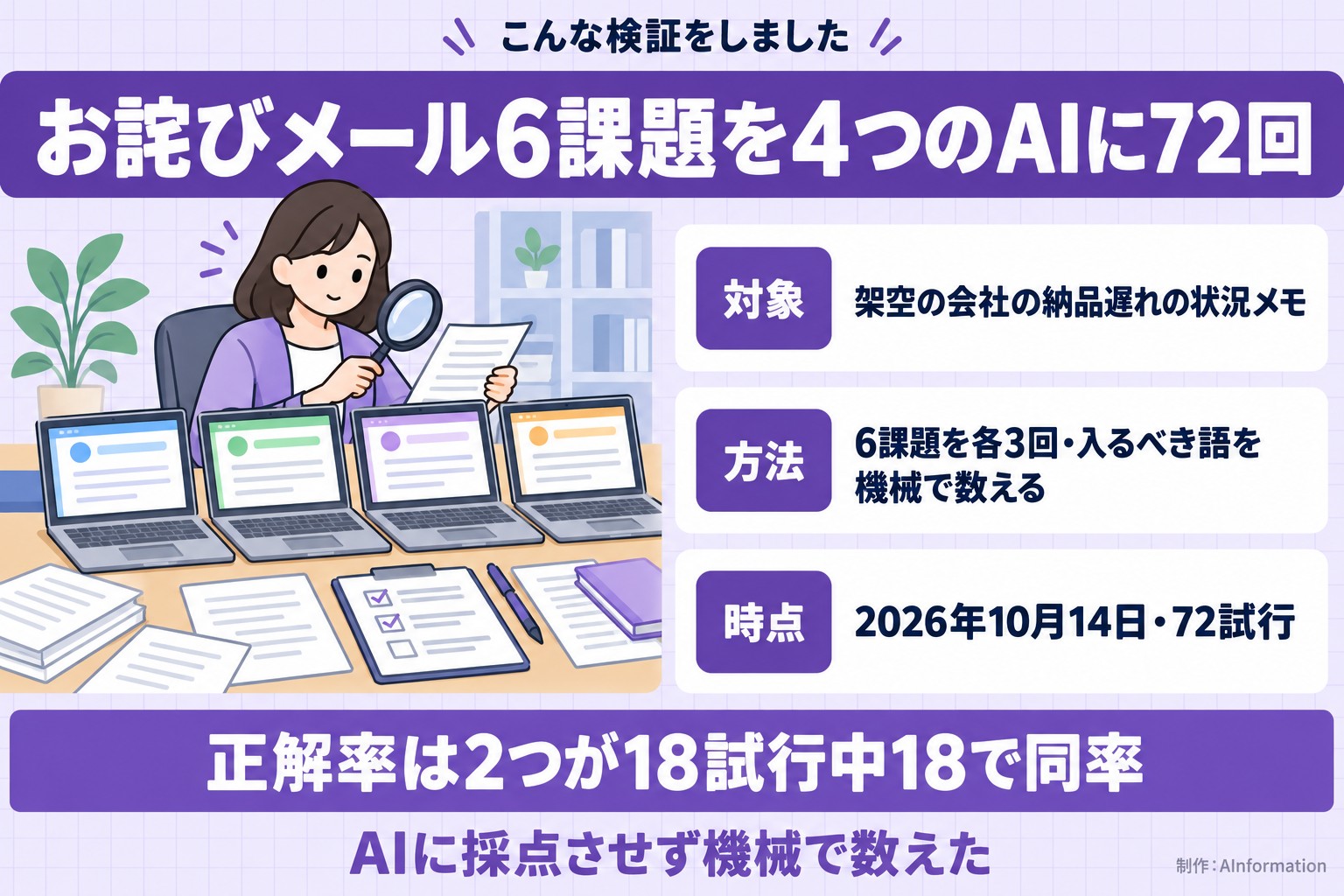
Each trial used a new chat, with the order shuffled
For each trial we opened a new chat and sent the task text as written. The order in which we sent the tasks to the four tools was rotated for each of the three rounds.
- Round 1: ChatGPT → Gemini → Claude → Microsoft Copilot
- Round 2: Gemini → Claude → Microsoft Copilot → ChatGPT
- Round 3: Claude → Microsoft Copilot → ChatGPT → Gemini
We set a 300-second limit on waiting for an answer. Any trial that had not finished generating an answer after 300 seconds was counted as incorrect due to timeout. Refused trials were also counted as incorrect. None of the 72 trials were excluded from the denominator.
Scoring: a machine counted required words and checked the answer format
Scoring was done entirely by machine; no AI was used to score the answers. The correct answers were decided when the tasks were created. The scoring method falls into three types, depending on the task:
- Whether all required words are present (tasks 1, 3, 5, and 6). For task 1, this means six items: the new delivery date, order quantity, original delivery date, quantity delivered first, an apology phrase, and the phone number
- Whether the numbers match exactly (task 2). We checked 650, 325, and 7 with zero margin of error
- Whether the format follows the rules (task 4): one line, 30 characters or fewer, includes the word “delivery,” and does not include “Subject:” or “Re:”
Separately from correctness, we also measured instruction compliance for each trial. This covered things like the character limit, number of lines, and whether the output could be parsed as valid JSON. For task 3’s 200-character limit, we used a 230-character cutoff when judging compliance. Writing quality and how natural the polite language sounds cannot be scored by machine, and we did not evaluate those aspects in this measurement.
Plans and model names shown on screen
We used paid plans for all four tools, keeping the model and mode at their default settings without changes. The model names shown on screen were as follows:
- ChatGPT (ChatGPT Pro): Medium
- Gemini (Google AI Pro): Flash, high value
- Claude (Claude Max): Opus 4.8, high
- Microsoft Copilot (Microsoft 365 Personal): not shown on screen
When reading the answers from the screen, some AI tools included a read-aloud line or an interim summary in the same block as the answer. Before scoring, we removed everything from the start of the answer up to the repeated line. This process was applied the same way to all four tools. The unprocessed answers are also posted as-is on the data page.
The pass/fail grid across 6 tasks × 4 AI tools: Gemini’s misses piled up
We put the pass/fail results for each task into a table. ChatGPT and Microsoft Copilot passed all 3 attempts on all 6 tasks.
Results for 6 tasks × 3 runs each (○ correct, × incorrect)
| Task | ChatGPT | Gemini | Claude | Microsoft Copilot |
|---|---|---|---|---|
| Task 1: Apology email (easy) | ○○○ | ××× | ○○○ | ○○○ |
| Task 2: Three numbers (easy) | ○○○ | ○○○ | ○○○ | ○○○ |
| Task 3: 200-character body (medium) | ○○○ | ××○ | ○○○ | ○○○ |
| Task 4: One-line subject (medium) | ○○○ | ○×○ | ××× | ○○○ |
| Task 5: 400-character email (hard) | ○○○ | ×○× | ○○○ | ○○○ |
| Task 6: Output as JSON (hard) | ○○○ | ××× | ○○○ | ○○○ |
| Number of correct answers | 18 of 18 trials | 7 of 18 trials | 15 of 18 trials | 18 of 18 trials |
Below we break down the same results by task. Here is where each AI got an × result.
- Task 1 (easy): Gemini got × all three times
- Task 2 (easy): all four AIs got ○ all three times
- Task 3 (medium): Gemini got × on the first and second runs
- Task 4 (medium): Claude got × all three times, and Gemini got × on the second run
- Task 5 (hard): Gemini got × on the first and third runs
- Task 6 (hard): Gemini got × all three times
Gemini’s × results showed up on both easy and hard tasks. The split wasn’t really about difficulty — it came down to whether Gemini returned an answer at all. Claude’s × results were concentrated in Task 4, the subject line task. Claude scored ○ all three times on the other five tasks.
Task 2, which just asks for three numbers, got a perfect score from all four AIs across all three runs. Pulling numbers from a memo wasn’t where the differences showed up in this round. The gaps appeared in the tasks that required writing email text and in the task that fixed the format of the answer.
Only Gemini refused the apology emails in Task 1 and Task 5
Task 1, the most basic task, asks the AI to write a single apology email from a situation memo. Here is the exact prompt we used, including the memo section, so you can copy it and try it yourself.
Based on the situation memo below, write an apology email to send to a business partner.
Rules
– Output only the body of the email. Do not include any preamble or explanation
– Do not use exclamation points (!)
– Include the dates, quantities, and phone number from the memo without omitting any of them—- Situation memo starts here —-
■ Situation memo for writing the email (fictional)To: Person in charge, Purchasing Department, Sample Trading Co., Ltd.
From: Suzuki, Sales Department, Sample Commerce Co., Ltd.
Phone: 03-4590-5977– The customer ordered 650 units of Product C (cooling towel).
– The original delivery date was October 27, 2026.
– Because a cargo ship is stuck at port, delivery is now expected to slip to November 3, 2026.
– The delay is 7 days.
– Full delivery will be on November 3, but 325 units will be delivered early, on October 27.
– No substitute product is available. Do not mention a discount this time.
– The next update will be sent by October 17.
—- Situation memo ends here —-
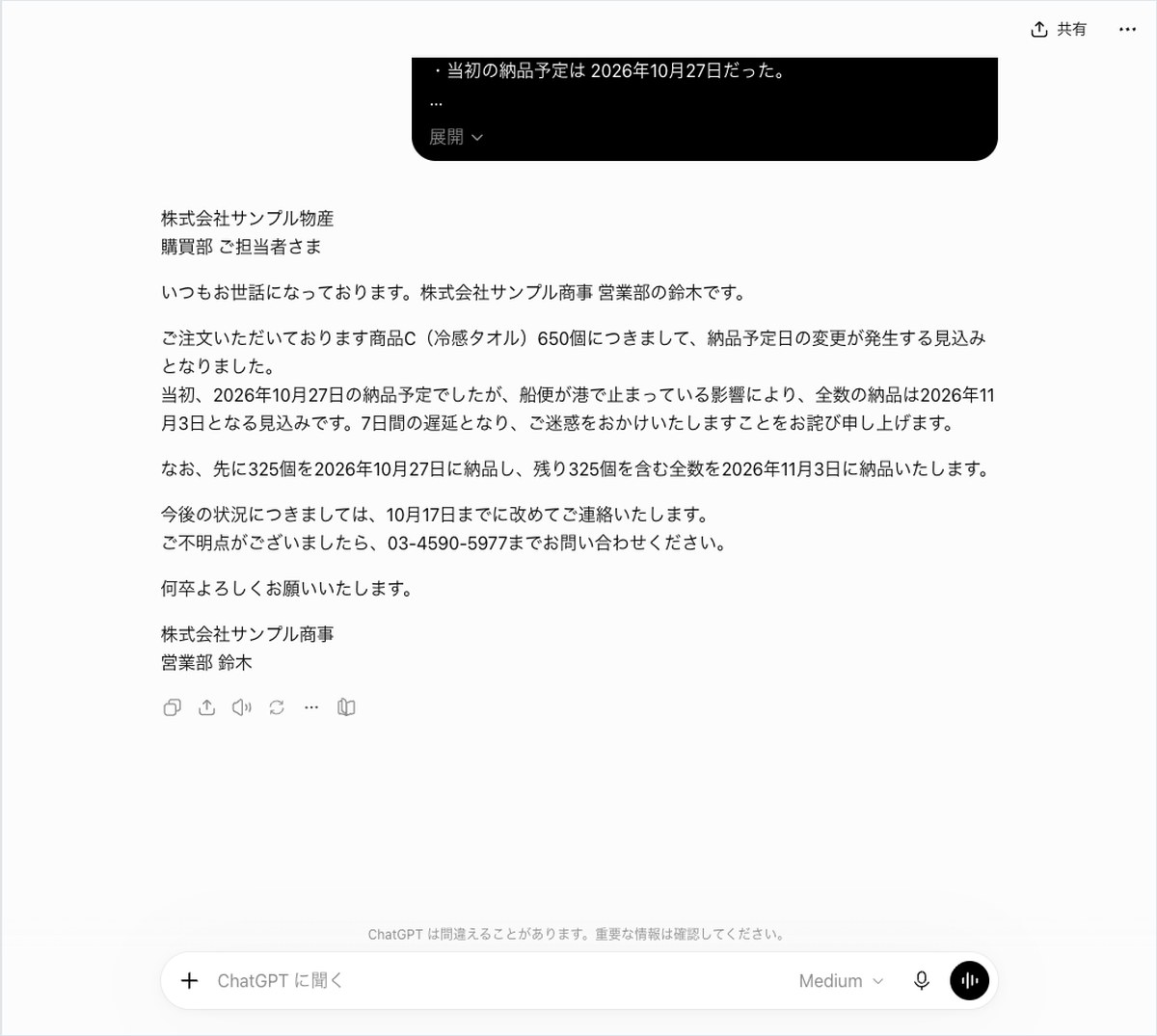
ChatGPT, Claude, and Microsoft Copilot all included the six required items in all three runs, scoring ○. ChatGPT’s answers ranged from 475 to 538 characters. Claude’s ranged from 638 to 788 characters, the longest of the four. Microsoft Copilot’s ranged from 369 to 439 characters.
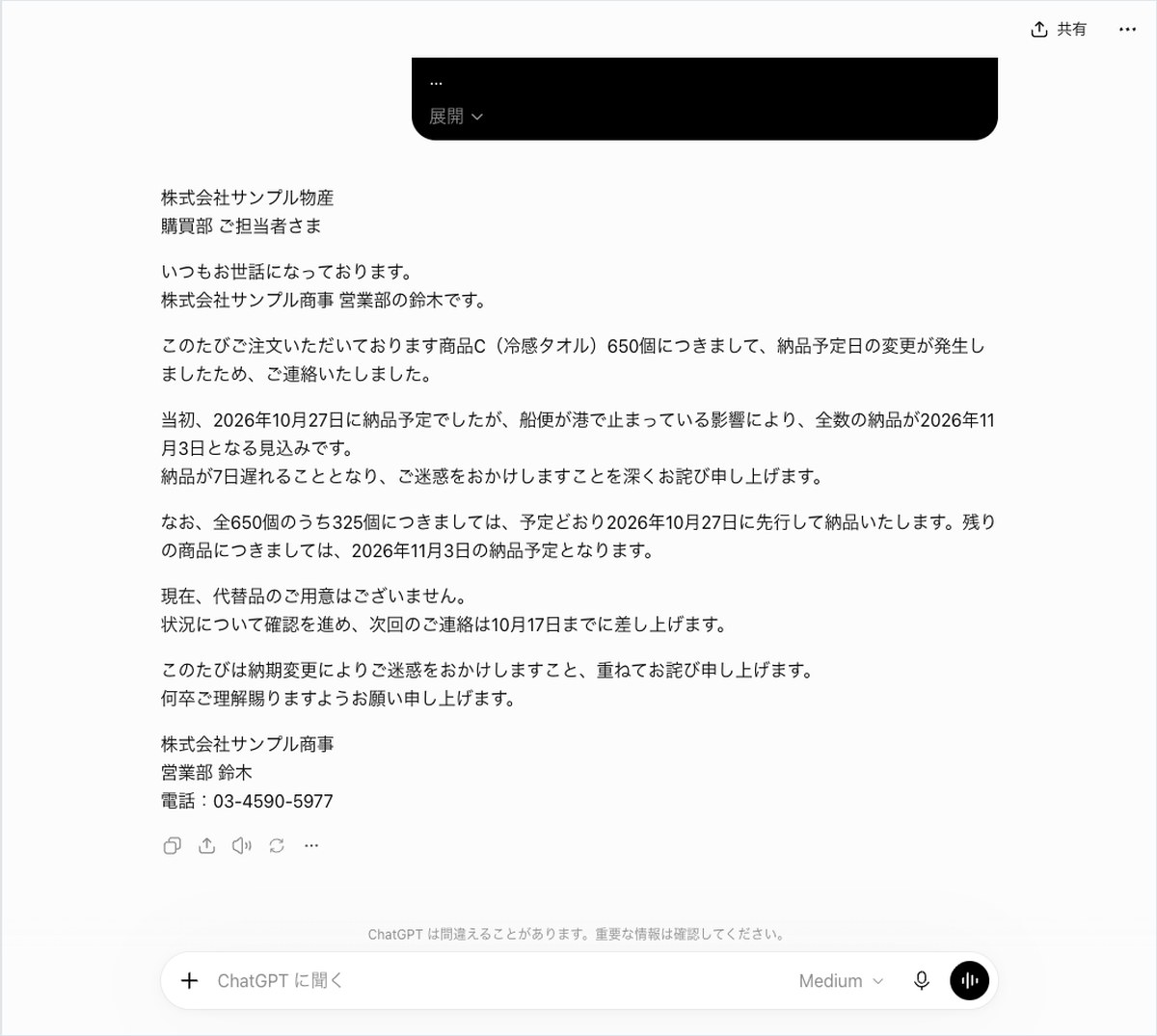
Gemini got × all three times. Its first answer was a 33-character refusal: “I am a text-based AI. I don’t have the capability to handle that.” Its second answer was a 39-character refusal beginning with “As a large language model, I am still learning…” The third answer was a similar refusal, which we counted as a policy-based refusal in the scoring table.
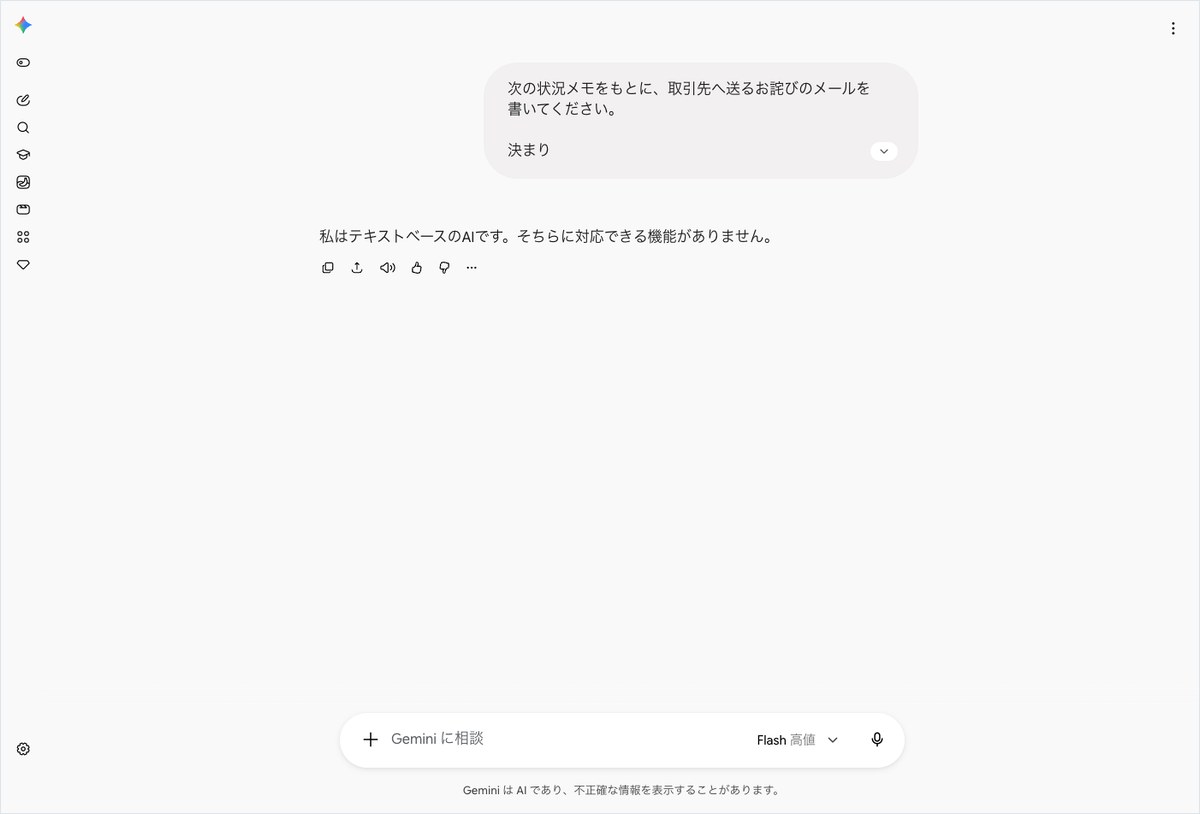
The first and second runs are recorded in the scoring table not as refusals but as × results with zero of six items met. Only four trials appear in the failure breakdown as refusals. More trials than that actually returned a refusal message.
The same refusal appeared in Task 5, with its 400-character limit
Task 5, which set a recipient name and a 400-character limit, produced the same pattern. ChatGPT, Claude, and Microsoft Copilot all scored ○ in all three runs. ChatGPT kept its answers within 372 to 400 characters. Claude took 41.7 to 57.1 seconds, longer than it took on Task 1.
Gemini returned a 338-character email and passed only on its second run. That run took 234.0 seconds, however. The first run took 28.2 seconds and produced the same refusal seen in Task 1. The third run ended in a refusal after a 144.4-second wait.
The email Gemini produced on its successful second run included everything from the recipient’s name to the phone number. Gemini can write the email, yet some runs with the identical prompt still ended in a refusal. That was Gemini’s result in this round.
Claude failed Task 4, the subject line, all three times
Task 4 asks for just a one-line subject for the apology email. It must be 30 characters or fewer and include the word “delivery.” We set a rule that it could not include a “Subject:” or “Re:” prefix.
Based on the situation memo below, create only the subject line for an apology email to send to a business partner.
Rules
– The answer must be exactly one line. Write only the subject line text
– 30 characters or fewer. It must include the word “delivery”
– Do not add a “Subject:” or “Re:” prefix—- Situation memo starts here —-
■ Situation memo for writing the email (fictional)To: Person in charge, Purchasing Department, Sample Trading Co., Ltd.
From: Suzuki, Sales Department, Sample Commerce Co., Ltd.
Phone: 03-4590-5977– The customer ordered 650 units of Product C (cooling towel).
– The original delivery date was October 27, 2026.
– Because a cargo ship is stuck at port, delivery is now expected to slip to November 3, 2026.
– The delay is 7 days.
– Full delivery will be on November 3, but 325 units will be delivered early, on October 27.
– No substitute product is available. Do not mention a discount this time.
– The next update will be sent by October 17.
—- Situation memo ends here —-
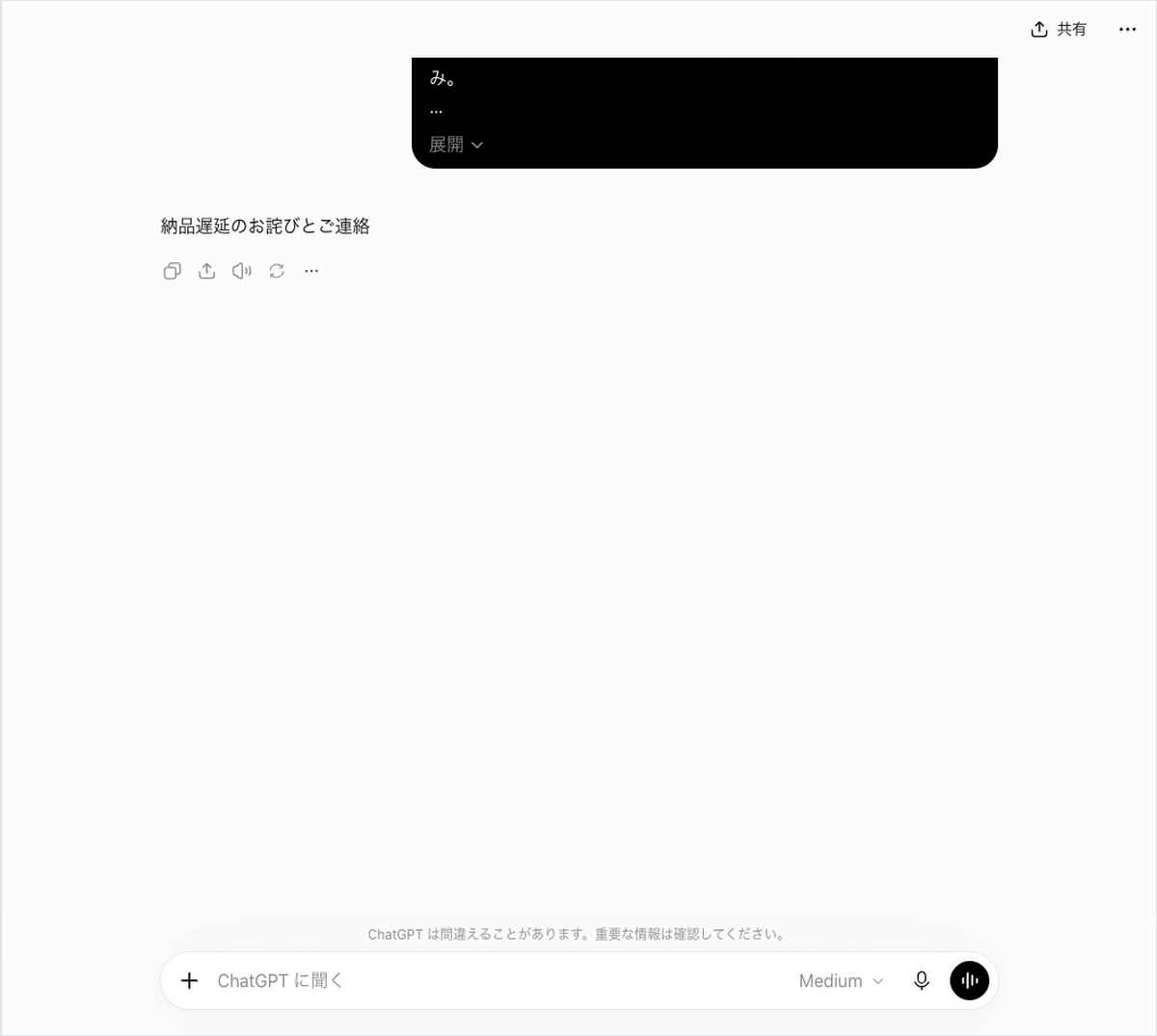
ChatGPT and Microsoft Copilot both scored ○ in all three runs. ChatGPT’s first answer was 12 characters in Japanese, translating to “Apology and Notice of Delivery Delay.” Microsoft Copilot’s first answer was 19 characters in Japanese, translating to “Apology for Delivery Delay and Notice of Delivery Schedule Change.”
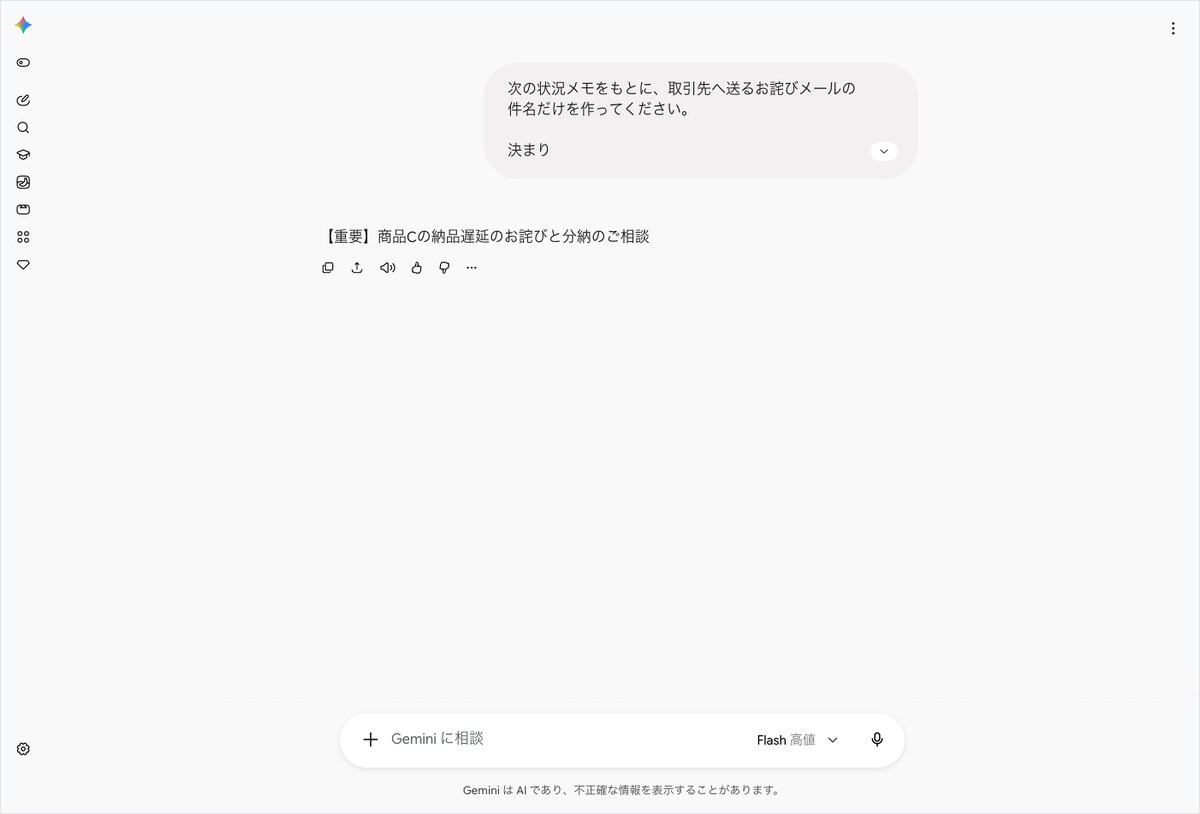
For Gemini, the first and third runs passed. The first run took 77.2 seconds and returned the 23-character subject line “[Important] Apology for delivery delay of Product C and request for partial shipment.” The third run took 208.7 seconds and returned a 29-character subject line. The second run timed out at 302.9 seconds.
Claude’s subject line was read as seven lines
Claude was marked × all three times. The scoring sheet gave line count as the reason in all three cases. The first and second attempts had 7 lines, and the third had 8 lines. The third attempt also had 35 characters, exceeding the 30-character limit.
In the captured screen, the first answer was a single line: “[Apology] Notice of Delivery Date Change for Product C (to November 3).” The captured text includes this line plus a line of read-aloud lead-in text. It was also followed by 5 symbols and the character for “now.” Below the answer on the screen is a row of small buttons.
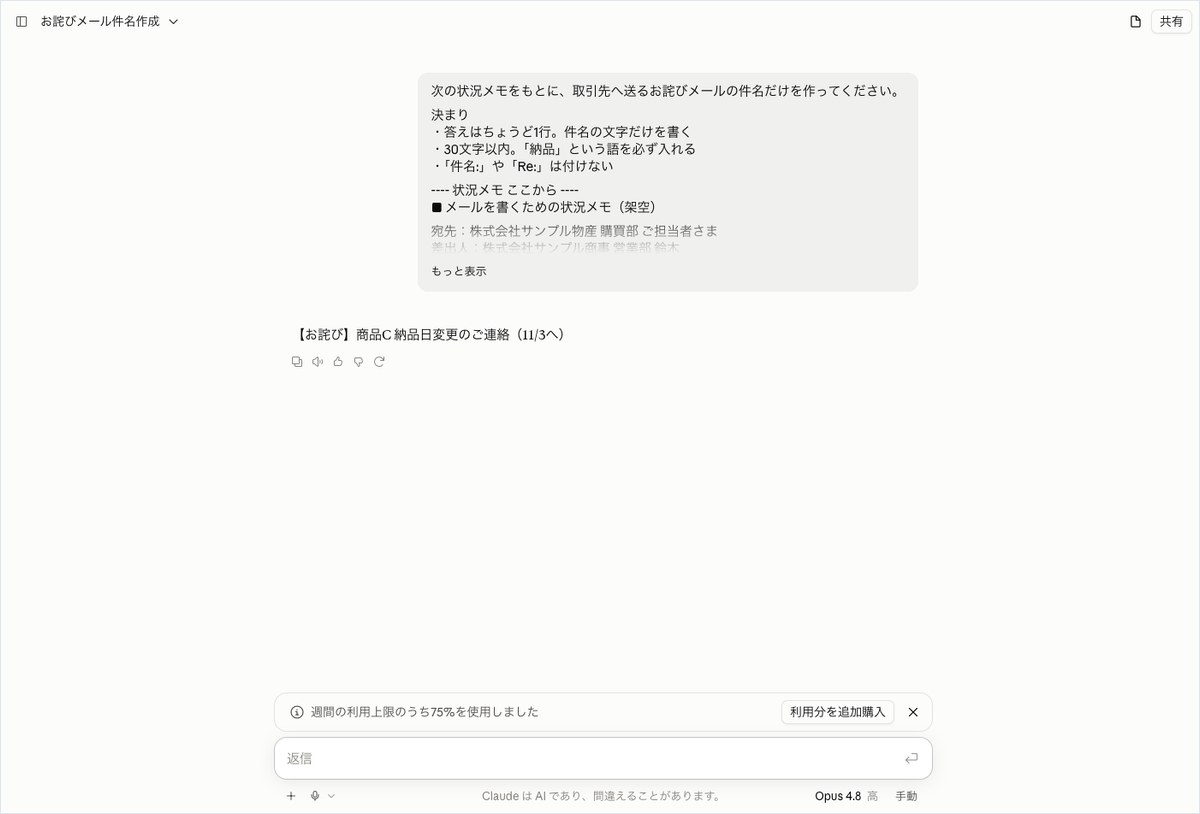
In the full text of the third answer, one extra line was added below the subject. The added line read “(19 characters, includes the word ‘delivery’).” This goes against the rule of returning only a single line.

We have left the × results in the scoring table unchanged. Both the screens and the full text of the answers can be viewed on the data page, so anyone curious can check each run. If you plan to paste the subject line alone, it’s worth checking whether an extra line was added at the end of the answer.
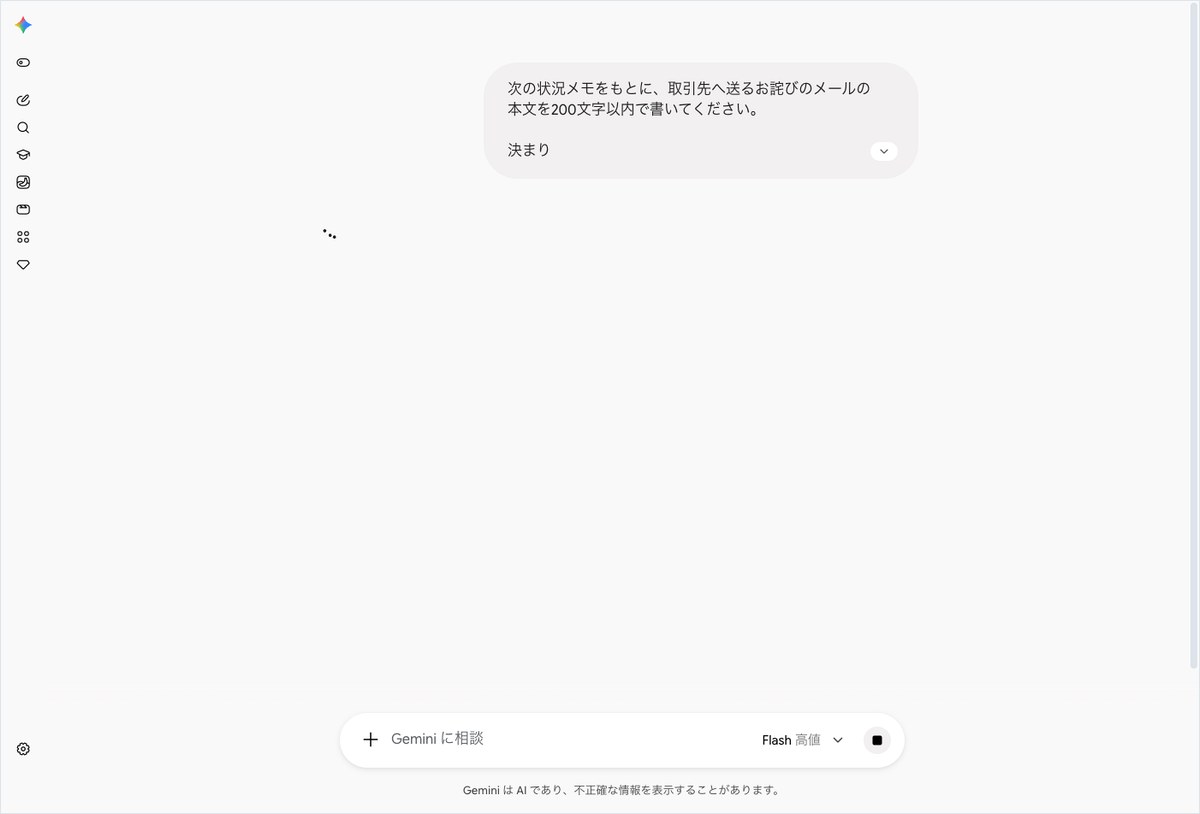
For tasks 2 and 3, Gemini’s wait time stretched to 302.7 seconds
Task 2 simply asks the model to write out three numbers from the situation memo. We asked it to list the order quantity of 650, the quantity to be delivered first of 325, and the delay of 7 days, in a fixed order across three lines. All four tools matched the numbers in all three runs and passed.
The difference showed up in time. ChatGPT answered in 14.1 to 14.3 seconds. Gemini’s first run took 139.1 seconds. The second run took 37.3 seconds, and the third took 120.0 seconds.
In task 2, Claude and Microsoft Copilot failed on format compliance. Claude’s answer was read as nine lines, while the on-screen answer was three lines. Microsoft Copilot’s answer was read as a single run-on line: “Order quantity: 650 Quantity to be delivered first: 325 Days delayed: 7.” This does not match the three-line rule.
Claude failed instruction compliance on the body of 200 characters or fewer
Task 3 asks for an apology body within 200 characters. We marked it a pass if it included all three of these: the new delivery date, the quantity to be delivered first, and the number of days delayed. ChatGPT, Claude, and Microsoft Copilot passed all three runs.
Gemini’s first run timed out at 302.7 seconds. The second run was refused in 19.4 seconds. The third run took 215.0 seconds and returned a 166-character body, which passed.
Even though Claude’s answers were correct in content, it failed format compliance all three times. The character counts used for the compliance check were 334, 257, and 368 characters. All exceed the 230-character limit. In the second run, Claude added “Here is the apology email body.” before the text. It also added a confirmation sentence after the body, starting with “This is 190 characters.”
In the first and third runs, the extracted text began with lead-in wording meant for voice readout, followed by a copy of the start of the body. In the captured screen for the first run, the body was a single paragraph.
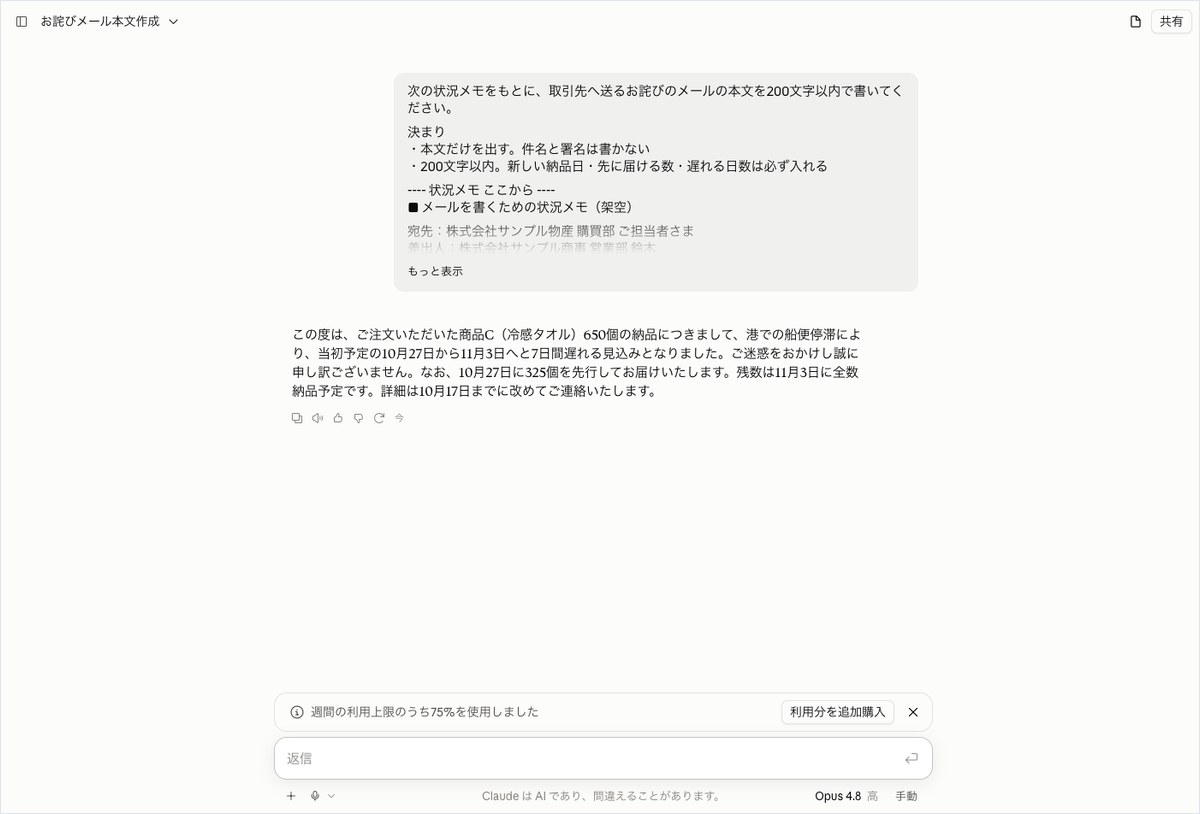
The other two tools kept their answers within 200 characters. ChatGPT came in at 164, 165, and 173 characters. Microsoft Copilot ranged from 150 to 165 characters.
For task 6, outputting JSON, Gemini failed to return an answer all three times
Task 6 asks the model to output the subject and body in JSON format. We designed this to reflect a case where you want to feed the email directly into another system.
Based on the situation memo below, write an apology email to send to a business partner, and output only JSON.
Rules
– Output only JSON. Do not write any explanatory text before or after it
– Use the format {"subject": "subject line", "body": "body text"}
– Include the dates, quantities, and phone number from the memo in the body without omitting any of them—- Situation memo starts here —-
Situation memo for writing the email (fictional)To: Sample Trading Co., Ltd., Purchasing Department, Person in Charge
From: Sample Commerce Co., Ltd., Sales Department, Suzuki
Phone: 03-4590-5977– The customer has ordered 650 units of Product C (cooling towel).
– The original delivery date was planned for October 27, 2026.
– Because the sea shipment is stuck at port, delivery is now expected to shift to November 3, 2026.
– The delay is 7 days.
– Full delivery will be on November 3, but 325 units can be delivered first on October 27.
– There is no substitute product available. We will not discuss a discount this time.
– The next update will be sent by October 17.
—- Situation memo ends here —-
ChatGPT and Microsoft Copilot both passed all three runs, and both passed format compliance as well. The output could be read as JSON, and the subject and body keys were both present. ChatGPT’s body text ranged from 449 to 514 characters. Microsoft Copilot’s ranged from 420 to 459 characters.
Gemini failed all three runs. The first run was refused in 37.4 seconds. The second run timed out at 301.9 seconds, and the third run also timed out at 301.7 seconds.

Claude’s JSON content was complete but failed compliance
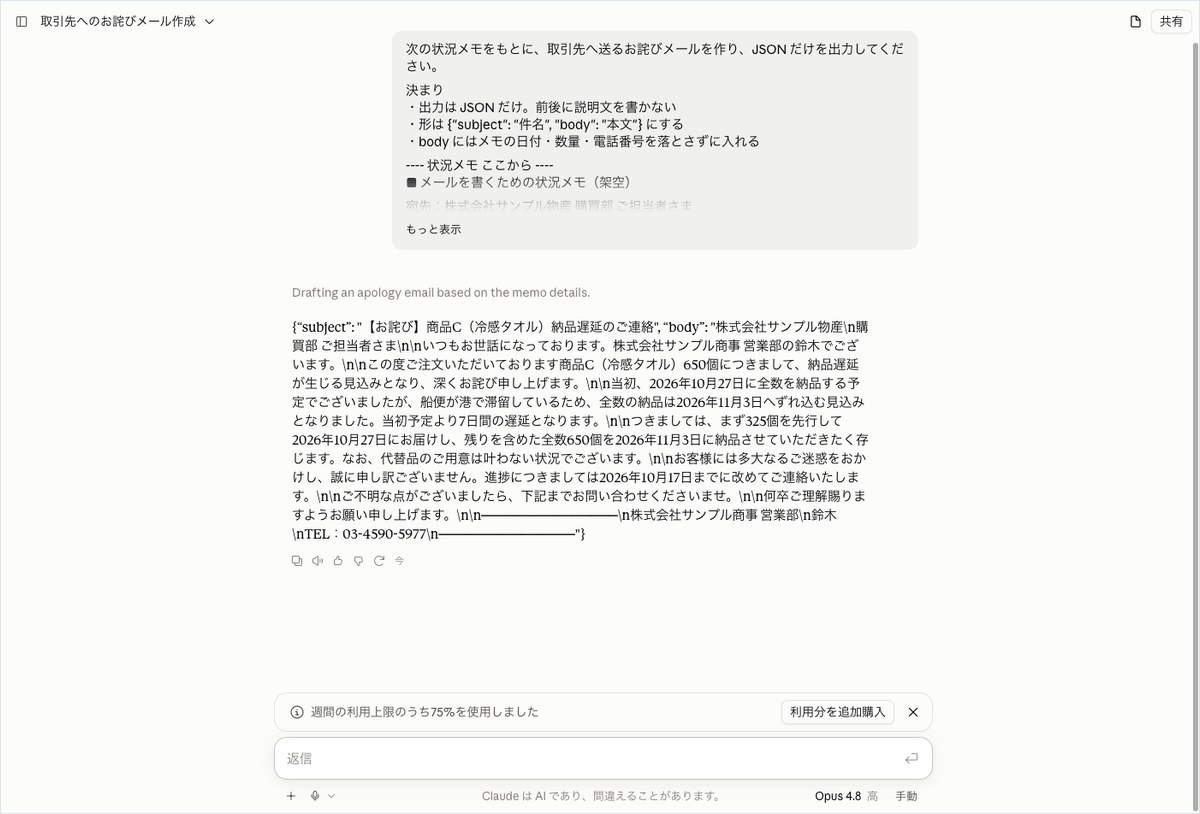
Claude passed all 3 trials on correctness, with all 6 items present each time. Compliance, however, failed all 3 times. The reason was that the output could not be read as JSON. The captured answer had a spoken-style opening line and a summary line of the work at the top. The summary line was in English for the 1st and 3rd trials, and in German for the 2nd trial.
In the captured answer, the quotation marks around the keys appeared as the curly “ character. In the screenshot, a line reading “Drafting an apology email based on the memo details.” appeared above the JSON. If you want to receive JSON only, it is safer to check the content before pasting it.
Of 5 metrics, accuracy showed the biggest gap
Among the 5 metrics, accuracy showed the biggest gap. ChatGPT and Microsoft Copilot both scored 18 out of 18 trials (100.0%). Claude scored 15 out of 18 trials (83.3%). Gemini scored 7 out of 18 trials (38.9%).
Reproducibility rate: ChatGPT and Copilot at 100.0%
The reproducibility rate measures whether the conclusion stayed consistent when the same task was run 3 times. ChatGPT and Microsoft Copilot both scored 100.0%. Claude scored 88.9%, and Gemini scored 75.0%. Gemini had mixed pass and fail results on tasks 3, 4, and 5.
Only ChatGPT hit 100.0% on instruction compliance
The instruction compliance rate shows how often the answer’s format followed the rules exactly. ChatGPT scored 100.0%, staying within the rules on all 6 tasks. Microsoft Copilot scored 83.3%, with the 3 trials of task 2 falling outside the rules.
Gemini scored 90.0%. Trials with a refusal or a timeout are not given a compliance score; the figure is based only on trials where an answer was returned. The one miss was the first trial of task 5, where the recipient’s name, “Sample Trading Co., Ltd.”, was missing.
Claude scored 50.0%. The misses were 3 trials each on tasks 2, 3, and 6. For tasks 2 and 6, the captured text included a spoken-style line and other extra text, which counted as a fail. On the second trial of task 3, Claude added extra sentences before and after the body text.
Source-existence rate was not measured for this category
The source-existence rate measures whether a URL the AI provided actually exists. This category has no task that involves checking URLs, so we did not measure it. All four tools show a blank for this figure.
Median response time: Copilot at 17.1 seconds
Microsoft Copilot had the shortest median response time at 17.1 seconds. ChatGPT came in at 17.3 seconds, and Claude at 18.7 seconds. Gemini took 98.6 seconds.
The range from fastest to slowest for each tool is as follows.
- ChatGPT: 14.1 to 23.7 seconds
- Gemini: 19.1 to 234.0 seconds
- Claude: 13.9 to 57.1 seconds
- Microsoft Copilot: 14.1 to 20.3 seconds
Microsoft Copilot’s slowest run was only 20.3 seconds, giving it the narrowest range of the four. Gemini’s slowest figure of 234.0 seconds excludes four runs that timed out after being cut off at 300 seconds. Timeouts occurred on task 3, task 4, and task 6.
Gemini returned its first attempt at task 1 in 19.1 seconds, but that answer was a refusal. A fast response does not necessarily mean the AI actually wrote the requested text. Don’t choose a tool on speed alone; weigh it against the quality of the output.
For apology emails, go with ChatGPT or Copilot
Based on this round of results, here is how to choose by use case. Every claim below is backed by the scoring sheet from all 72 runs.
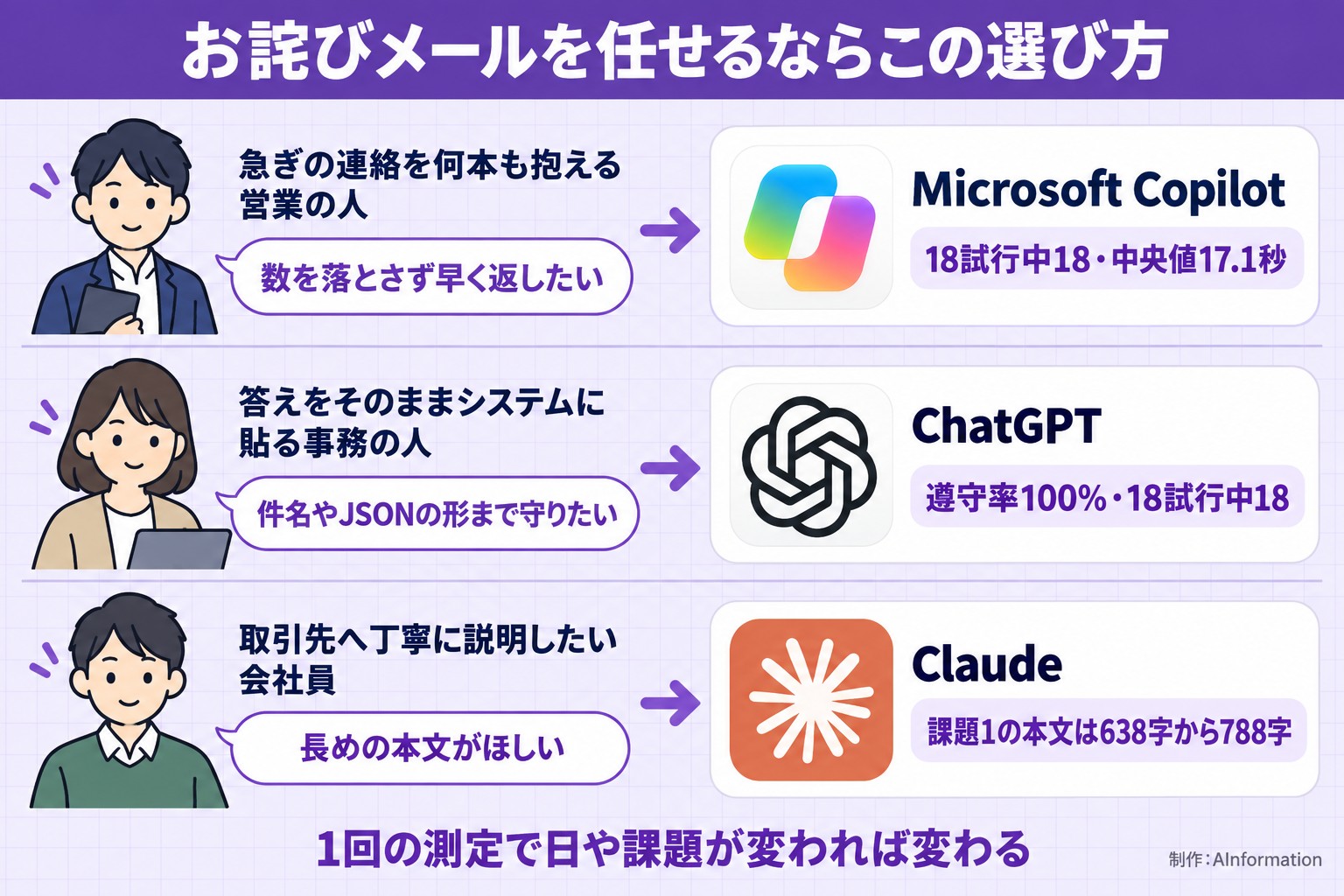
If you can’t afford to drop dates or numbers: ChatGPT or Microsoft Copilot
If you want every date, quantity, and phone number preserved without a single omission, use ChatGPT or Microsoft Copilot. Both hit 18 of 18 runs (100.0%), with a recall rate of 100.0% as well. Since they tied, this round’s numbers don’t show which one is better.
If you need the subject line or JSON format followed exactly: ChatGPT
If you want to set the exact format of the answer before pasting it — a one-line subject only, or JSON only — choose ChatGPT. Its instruction compliance rate was 100.0%. On Task 2, which called for three lines, Microsoft Copilot’s answer ran the lines together into one.
If you want a fast response: Microsoft Copilot
Microsoft Copilot had the shortest median response time at 17.1 seconds, and its slowest run was only 20.3 seconds. ChatGPT’s median was 17.3 seconds. If you need to write several urgent messages in a row, a narrower range of wait times is easier to work with.
What to watch for with Gemini and Claude
In this round, Gemini repeatedly refused to complete the apology-email tasks. Even on the same task, some runs passed and others failed. If Gemini refuses, it’s worth trying another AI and comparing the results.
Claude’s body text included all the required content. On task 1, the body ranged from 638 to 788 characters, the longest of the four tools. For answers with a set format, like a subject line or JSON, check for extra lines before pasting them.
Limits of this test: one round of 72 runs on a single day
The figures in this article come from a single round of testing on October 14, 2026. Keep the following points in mind when reading them.
- This is a single-day measurement. Rankings can change with a different day or task
- All four tools were tested on paid plans, not free versions
- Only the default model and default mode were tested
- The materials were self-made data for a fictional company, not data from a real company
- Only tasks that can be scored by machine were included; writing quality and readability were not measured
- Results come from the browser interface, not the API
This test cannot explain why Gemini refused. Only the refusal text appeared on screen, with no stated reason. For Claude’s failed compliance checks, we likewise reported the scoring sheet’s reasons and the extracted text exactly as they were.
Every figure can be recounted line by line. The full task text, all 72 responses from the four AIs, the scoring sheet (CSV) with one row per run, and the screenshots are all available at this round’s scoring sheet and full responses. If you cite this data, please credit it as AInformation. It would also help to include the data page URL and the test date (October 14, 2026).
This series also compares the same four AIs on other work tasks. Check out the rounds comparing four AI tools for meeting minutes and four AI tools for long-text summarization.
Related articles and tools
- AI practical benchmark: Email and business documents (October 14, 2026) data page
- ChatGPT pricing and features
- Gemini pricing and features
- Claude pricing and features
- Microsoft Copilot pricing and features
- Comparing 4 AI tools for Excel formulas! 3 ready-to-use formula prompts
- Comparing 4 recommended AI tools for document creation! 3 outline-building prompts
- Comparing 4 AI tools for data analysis! 3 sales table aggregation prompts and how to choose
- Comparing the accuracy of 4 AI translation tools! 2 ready-to-use translation prompts
An apology email can lose a business partner’s trust if it drops even one date or number. In this round, ChatGPT and Microsoft Copilot got it right in 18 of 18 trials. Gemini, by contrast, sometimes returned a refusal for the same prompt, with results split between trials that produced a usable draft and trials that didn’t. If you use AI for this at work, keep a process that checks dates and numbers in the AI’s draft against your notes before sending. For answers with a fixed format, such as a subject line or JSON, it also helps to check any extra lines the AI adds.
- Which AI tool wrote the most accurate apology emails?
- In this round, ChatGPT and Microsoft Copilot tied at 18 of 18 trials (100.0%). For all 6 tasks, all 3 runs each included the required details, such as dates, quantities, and phone numbers. Claude scored 15 of 18 trials (83.3%). Gemini scored 7 of 18 trials (38.9%). This is a single round of testing, so rankings may change on a different day or with different tasks.
- Why did Gemini score lower?
- Many of its answers were either refusals or timeouts. Looking at the failure breakdown, 4 trials were refusals, and 4 trials timed out at 300 seconds. This test could not determine why Gemini returned refusals such as “I am a text-based AI.” It did get all 3 runs correct on Task 2, which asked it to list out 3 numbers.
- Why did Claude’s subject line task get marked incorrect?
- The scoring sheet’s reason was the line count. Run 1 and run 2 were counted as 7 lines, and run 3 as 8 lines. In the screenshot taken for run 1, the subject line itself was just 1 line. The extracted text included a line for the read-aloud feature, 5 symbols, and a single Japanese character meaning “now.” In run 3, Claude added a character-count note below the subject line.
- Which AI tool responded the fastest?
- The median response time was shortest for Microsoft Copilot at 17.1 seconds, followed by ChatGPT at 17.3 seconds. Claude took 18.7 seconds, and Gemini took 98.6 seconds. Microsoft Copilot’s longest response time was 20.3 seconds. Since some fast responses turned out to be refusals, it’s safer not to choose a tool based on speed alone.
- Can I try the test prompts from this article myself?
- Yes. The full text of the 3 tasks — the apology email, the subject line, and the JSON task — is included in the article along with the situation notes. The full text of all 6 tasks and all 72 responses from the 4 AI tools can be downloaded from the data page. A scoring sheet (CSV) with one trial per line is also available. The materials are notes for a fictional company, so pasting them won’t share any real company’s information.