
AI slop refers to text and video that is mass-produced quickly with AI and distributed without anyone checking its content. On October 28, 2026, we reviewed the official rules at nine platforms and found that only English Wikipedia bans creating content with AI outright. The remaining eight stop mass production and unchecked posting instead.
- What “AI slop” means, and how many people in Japan search for it (3,600 searches a month as of September 2026)
- Of nine platforms — including YouTube, Google Search, and Spotify — only English Wikipedia bans creating content with AI outright
- The other eight platforms stop four things instead: mass production, unchecked posting, undisclosed AI use, and rapid-fire bulk posting
- Of AInformation’s 507 AI tools, 11 can check whether text was written by AI, and all of them can be tried for ¥0
- For a white paper passage written by a human in 2016, Claude estimated a 15% probability that it was AI-written
- Four things creators of AI-made videos and books should change today, plus a prompt they can use to check their work
AI slop is a term for text, images, video, and music that are made quickly and in bulk with generative AI and then circulated without anyone checking the content. In March 2026, English Wikipedia banned using AI to write article text as a general rule. On July 21, music streaming service Deezer announced that over 50% of newly submitted tracks were now AI-made. Japanese Wikipedia was also discussing a proposed policy revision in October, but its details and when it will be decided are still unknown.
So does posting an AI-made video or article get it removed or demonetized? On October 28, 2026, AInformation compared the official rules at nine platforms: YouTube, Google Search, English Wikipedia, Japanese Wikipedia, Spotify, Deezer, TikTok, pixiv, and Amazon KDP. Only one — English Wikipedia — bans creating content with AI outright. The other eight don’t ban AI-made content itself; instead they target mass production, unchecked posting, and undisclosed AI use.
What “AI slop” means: unchecked, mass-produced AI content, banned outright at just one of nine platforms
What “AI slop” means
Let’s start with what “AI slop” actually means. The “slop” in “ai slop” is an informal English word. When we asked Claude for its meaning on October 28, it answered: “Slop means leftover food or pig feed in English; it refers not to AI use itself but to the thin, low-effort quality of mass-produced content.” In our search that day, we found no official definition set by a Japanese government ministry or industry group.
In other words, “AI slop” doesn’t mean “something made with AI.” It refers to AI-made content that’s mass-produced without human review or any added original value. This distinction matches the language used in YouTube’s and Google’s official rules. YouTube excludes from monetization “AI-generated content that gives the impression of being mass-produced.” Google’s spam policy also lists creating many pages without adding value for users as an example of a violation.
What we found reading the official rules at nine platforms
On October 28, AInformation opened the official help pages, guidelines, and announcements at nine platforms, one by one. We checked whether each one bans creating content with AI outright. Only English Wikipedia does, having made a general ban on AI-generated and AI-rewritten article text following discussions in March 2026. The other eight don’t ban AI-made content itself; instead, each stops one of the following four things.
- Mass production (YouTube, Google Search, Spotify)
- Posting without human review (Japanese Wikipedia)
- Undisclosed AI use (Amazon KDP; realistic synthetic videos on YouTube)
- Rapid-fire bulk posting (pixiv)
Deezer labels AI-made tracks and excludes them from recommendations, while TikTok is testing AI labels along with a setting that lets viewers choose how much AI content they see. None of the eight platforms has a rule that removes content simply because it was made with AI.
How many people search for “AI slop”
Using Google Keyword Planner on October 28, we found that monthly searches for the Japanese-language term for “AI slop” grew from 590 in October 2025 to 3,600 in September 2026. That’s a 3-month change of +89% and a year-over-year change of +1,025%. The English term “ai slop” grew from 1,600 to 6,600 searches over the same period.
Looking month by month, there was a peak of 4,400 searches in January 2026. After that it has held steady between 1,900 and 3,600 — this isn’t a term that spiked once and faded.
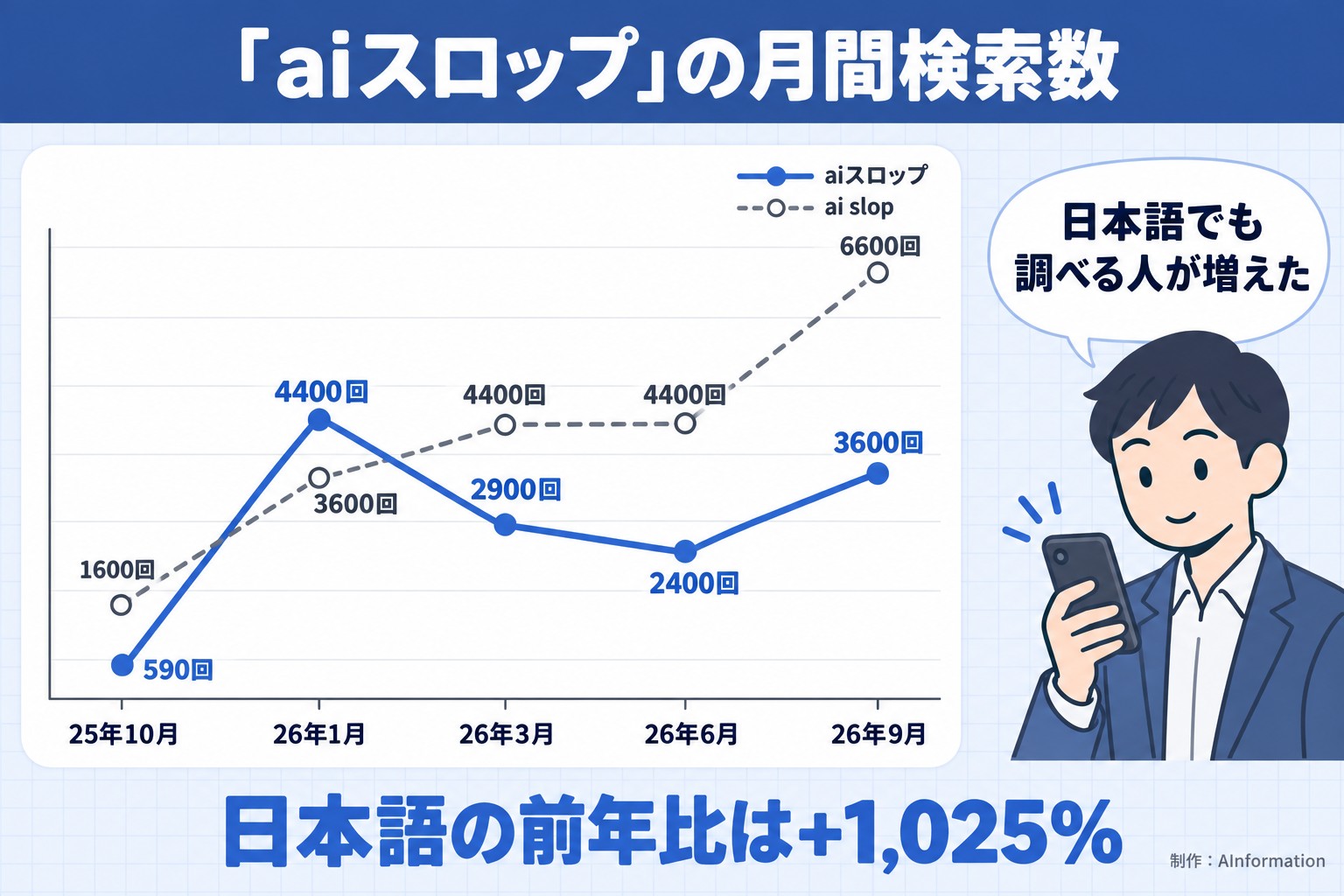
Monthly searches for “AI slop” in Japanese and English
| Search term | October 2025 | January 2026 | September 2026 | 3-month change / year-over-year |
|---|---|---|---|---|
| AI slop (Japanese term) | 590 | 4,400 | 3,600 | +89% / +1,025% |
| ai slop | 1,600 | 3,600 | 6,600 | +50% / +650% |
The rules at nine platforms, in one table
The table below lines up the official rules at nine platforms across three points: whether AI-made content itself is banned, what each rule actually stops, and the policy’s name and timing. We confirmed every entry against the official pages on October 28.
How nine platforms treat AI-made content
| Platform | AI-made content itself | What’s stopped | Policy name and timing |
|---|---|---|---|
| English Wikipedia | Banned as a general rule (proofreading and translation allowed) | AI-generated and AI-rewritten article text | Guideline on using LLMs to write articles / March 2026 |
| Japanese Wikipedia | Not banned | Posting without human review | LLM usage guideline / revision proposed in October |
| YouTube (monetization) | Not banned | Videos that give a template-based, mass-produced impression | Mass-produced content policy / July 15, 2025 |
| Google Search | Not banned | Creating large volumes of pages without adding value | Scaled content abuse policy / March 5, 2024 |
| Spotify | Not banned | Mass-produced spam and impersonation | Strengthened AI measures / September 25, 2025 |
| Deezer | Not banned | Labels AI-made tracks and excludes them from recommendations | In effect from June 2026 / announced July 21 |
| TikTok | Not banned | Testing AI labels and a setting to control how much AI content viewers see | Announced November 19, 2025 |
| pixiv | Not banned (pixiv Requests feature banned for now) | Rapid-fire bulk posting | AI-generated work settings / October 20, 2022 |
| Amazon KDP | Not banned | Undisclosed AI-generated text, images, or translations | KDP help page (AI content) |
Looking down the table, English Wikipedia is the only row with an outright ban. pixiv does not ban posting AI-generated work to the platform itself. However, for pixiv Requests, its commission system, pixiv announced on May 12, 2023, that it would “ban the handling of AI-generated works for the time being.” Whether this ban was still in effect as of October has not been confirmed in an official notice.
The order in which the rules were made
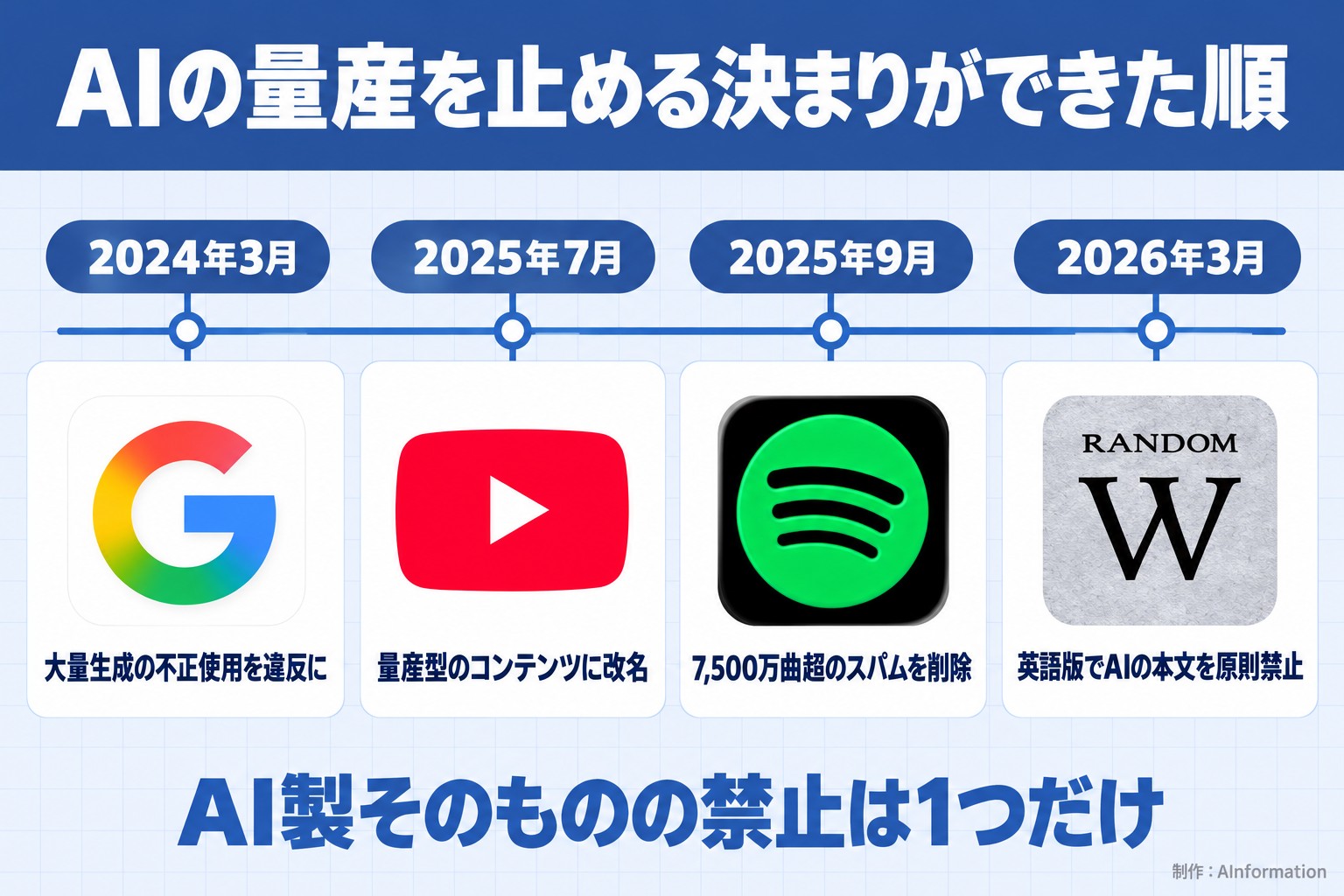
These rules did not appear all at once. pixiv was first, adding a setting and search exclusion for AI-generated works on October 20, 2022. Google stated on February 8, 2023 that it evaluates “content, not how it was created.” It then made scaled content abuse a new violation on March 5, 2024.
After that, YouTube renamed its monetization rule on July 15, 2025, and Spotify strengthened its anti-AI measures on September 25. English Wikipedia’s default ban took effect in March 2026. Deezer started tagging AI-made tracks in June.
Five things not stated officially
On the flip side, here are things that could not be confirmed officially as of October 28. Any of these, once decided, would change how AI creators need to operate.
- The content of the proposed revision to Japanese Wikipedia’s guideline and when it will be decided
- The number or share of videos YouTube uses as a threshold for judging mass-produced content
- The rough page count Google Search uses to flag mass-produced content
- Whether TikTok’s setting for choosing the amount of AI content is available in Japan
- Whether pixiv Requests’ ban on AI-generated works is still in effect
Since no clear threshold has been published, no one can say “you’re fine up to this many pieces.” The safe approach is to assume each piece will be reviewed on its own content, not counted against a quota.
English Wikipedia banned AI-written text by default in March 2026
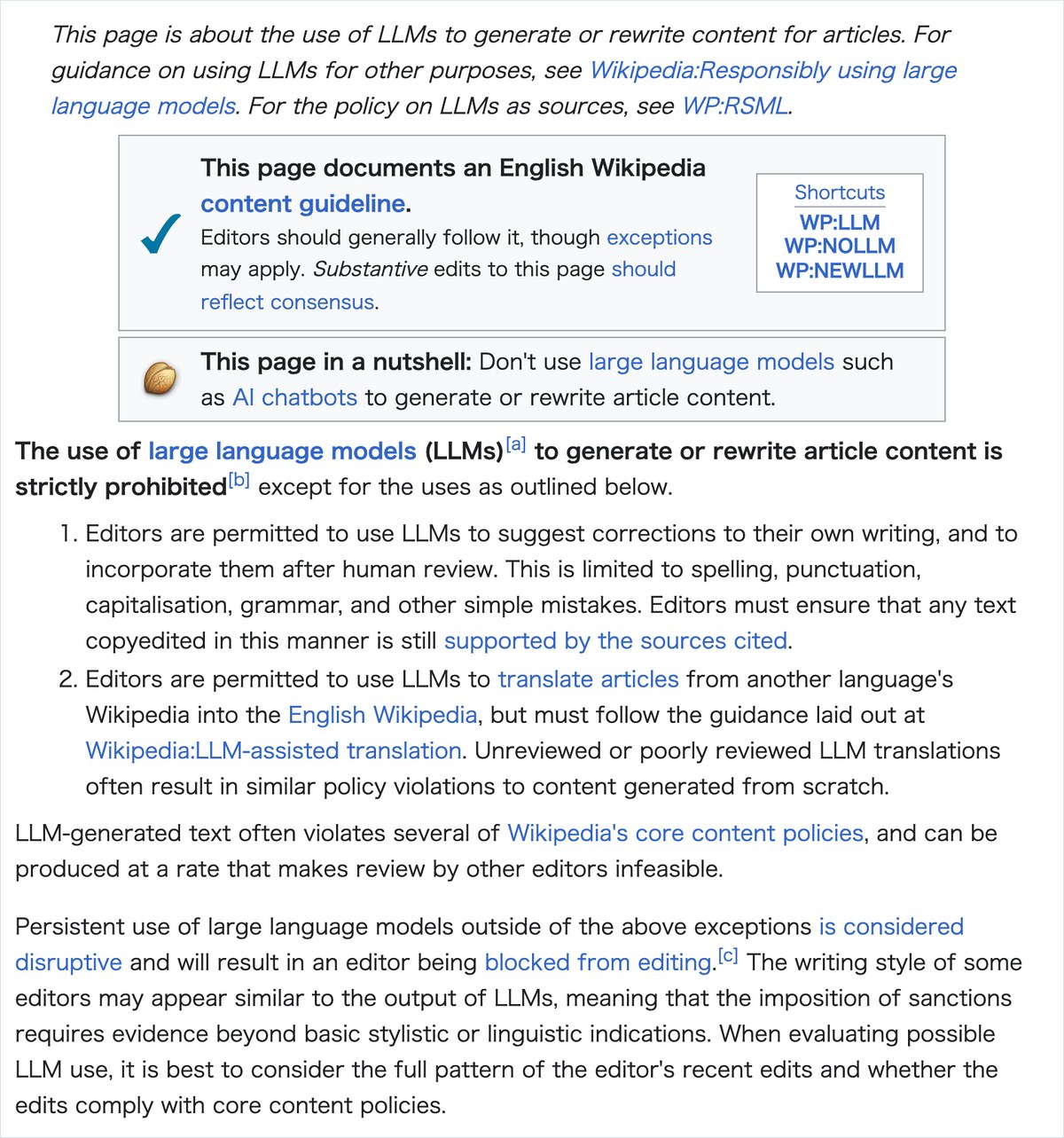
Of the nine platforms, English Wikipedia is the only one that bans creating content with AI itself. The guideline is called “Writing articles with large language models.” It states that “generating or rewriting article text with an LLM is strictly prohibited, except for the uses described below.” This form took shape through a discussion (RfC) in March 2026.
Only two uses are allowed: proofreading and translation
There are only two exceptions. One is using AI to fix typos or grammar in text you wrote yourself. The other is translating an article from another language edition. If someone keeps writing article text with AI, their editing privileges can be suspended.
At the same time, the guideline also states that taking action requires “evidence beyond markers of style or wording.” In other words, text won’t be penalized just because it reads as AI-like. This point connects to a later section, where we look at results from having Claude try to distinguish AI-written text.
Three markers that allow deletion without discussion
Another rule is G15, a speedy-deletion criterion. A page can be deleted without discussion if it shows three markers that can only be explained by unreviewed AI output: addressing the reader directly, citing sources that don’t exist, and telltale traces specific to a model. This covers articles that keep an AI’s leftover preamble addressed to the user, or that cite a nonexistent book as a source. This cleanup has drawn attention in English-speaking circles. In October, a Hacker News post titled “Wikipedia’s Cleanup of AI-Generated Content” gathered 484 points.
Japanese Wikipedia stops unverified posts
Japanese Wikipedia’s guideline asks editors not to post AI-generated text or citations without checking them first. It also states that articles strongly suspected of being generated by an LLM or similar tool are subject to deletion unless there are special circumstances. However, this is not a default ban like English Wikipedia’s. A proposed revision to this guideline was under discussion in October 2026, but its content and decision date could not be confirmed. It remains unclear whether it will move closer to the English version’s approach or stay as it is.
YouTube excluded “mass-produced content” from monetization starting July 15, 2025
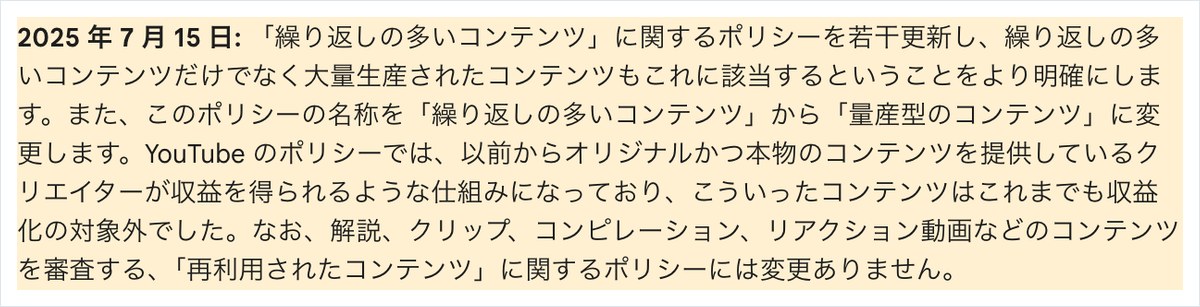
YouTube does not ban AI-made videos. What it restricts is monetization, and the target is “mass-produced content.” On July 15, 2025, it renamed the previous category, “repetitious content,” to this new name. It also added that mass-produced content is covered as well.
The monetization policy help page cites, as an example this applies to, “AI-generated content that is created using generic or unoriginal templates and gives the impression of being mass-produced.” What matters isn’t whether AI was used, but whether the content gives an impression of being mass-produced from a template.
In December, over 1 million channels a day used AI tools
YouTube CEO Neal Mohan wrote in his annual letter dated January 21, 2026 that in December, an average of more than 1 million channels a day used YouTube’s AI creation tools. The same letter states that YouTube will expand its existing systems for handling spam and clickbait to curb the spread of low-quality AI content.
YouTube also requires creators to disclose synthetic videos that are hard to tell apart from real footage. Keep in mind that videos realistically depicting AI-made people or events require disclosure before they’re published.
YouTube has not published the number or share of videos that triggers a mass-production judgment. From the official wording, it’s clear that this isn’t a rule where posting a certain number of AI-made videos automatically triggers action. We checked the free tier limits of AI video generation tools in our article testing 10 AI video generation prompts.
Google Search made mass production a violation on March 5, 2024, and cut low-quality content by 45%
Google Search also does not ban AI-written articles. In an official blog post on February 8, 2023, it stated that “the content is what matters, not how it was produced.” At the same time, it says that automatically generating content with AI or other tools mainly to manipulate search rankings is a spam policy violation.
In March 2024, a new “scaled content abuse” policy was added
On March 5, 2024, Google added three spam policies: expired domain abuse, scaled content abuse, and site reputation abuse. AI slop falls under the second one.
This update concluded on April 19, 2024. Google reported that low-quality, unoriginal content in search results dropped by 45%, exceeding its own projection of 40%.

Examples given in the August 2026 version
The spam policy was updated on August 28, 2026. Examples of scaled content abuse include creating many pages with generative AI or other tools without adding value for users. In other words, even if a page is written with AI, it does not count as this kind of abuse if it adds value for readers.
No published threshold indicates how many pages count as “scaled.” The question isn’t the page count, but what each page adds. This is exactly why it makes sense to add your own measured numbers and test results to an article drafted with AI.
Deezer receives 90,000 AI-made tracks a day; Spotify has removed over 75 million tracks
Music streaming platforms also don’t ban AI-made songs themselves. Spotify announced on September 25, 2025 that it would strengthen its protections against AI misuse, stating it had removed over 75 million spam tracks in the preceding 12 months. What it restricts is mass production and impersonation, not the act of releasing an AI-made song itself.
More than 50% of new tracks arriving on Deezer are AI-made
Music streaming service Deezer announced on July 21, 2026, that it receives 90,000 AI-made songs a day. That’s more than 50% of all new tracks it receives. On the other hand, AI-made songs account for only 1–3% of total streams.
Deezer also wrote that, looking at 2025 figures, up to 85% of streams for fully AI-generated songs were fraudulent. In other words, many of these songs are trying to earn money through fake plays. Starting in June, Deezer began labeling AI-made songs and removed them from its recommendations and editorial playlists.
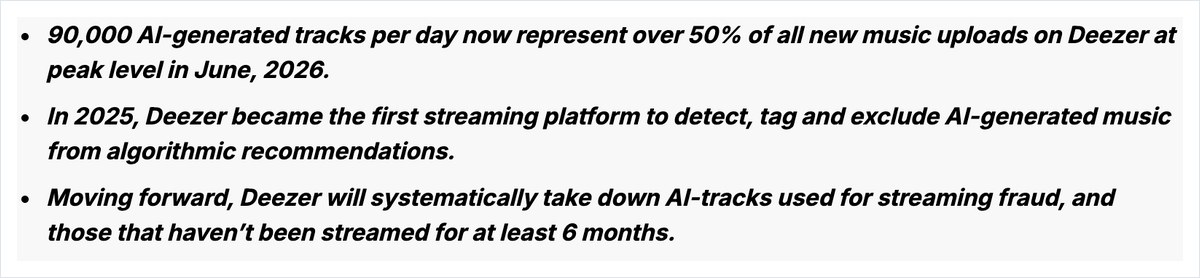
Deezer’s approach doesn’t remove AI-made content outright — it labels it and reduces how much people see. We could not confirm from official sources whether Deezer is available in Japan. For a discussion of the rights issues around using AI-made songs commercially, see our article on the Suno lawsuit.
TikTok, pixiv, and Amazon KDP track AI labels, disclosures, and posting volume
TikTok has labeled over 1.3 billion videos as AI
TikTok announced on November 19, 2025 that it would test a setting letting users choose how much AI-generated content appears in their recommendations. It also noted it had already labeled over 1.3 billion videos as AI-generated. TikTok doesn’t ban AI-made videos — instead, it lets viewers choose how much they see. The countries included in the test haven’t been disclosed, so it’s not yet clear whether it’s available in Japan.
pixiv relies on settings and measures against mass posting
pixiv announced on October 20, 2022 that it would add an AI-generated work setting, let users exclude such works from search, and create a ranking just for AI-generated works. A notice dated May 9, 2023 states: “If the same person posts AI-generated works many times in a short period, it can make it harder for others to find works in search results and elsewhere.” It also said it would strengthen measures against mass posting. On pixiv, there are two things to watch: correctly tagging AI-generated works, and not posting a large batch in a short time.
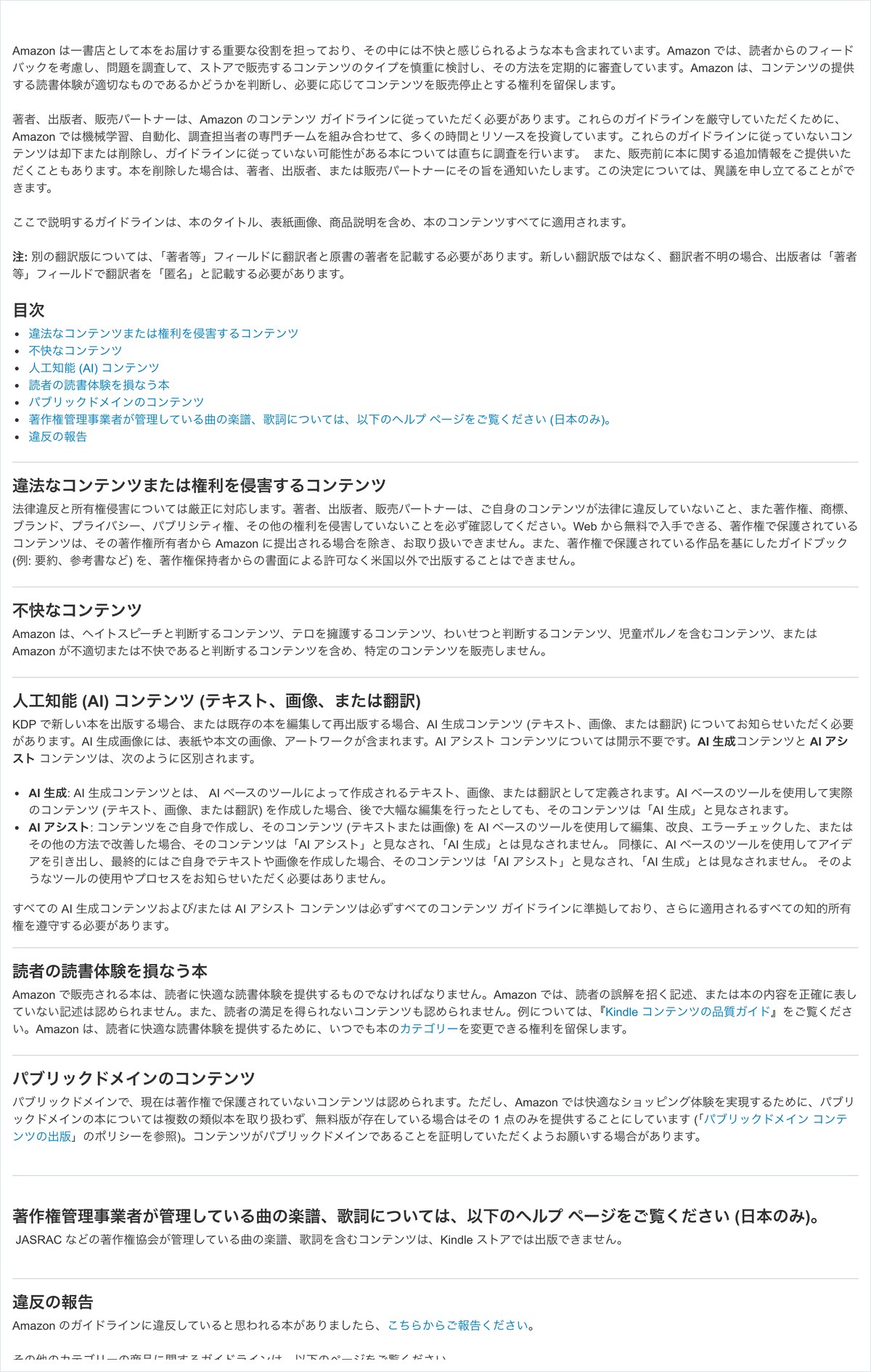
Amazon KDP requires three types of disclosure
Amazon KDP, which publishes Kindle books, requires authors to disclose AI-generated text, images, and translations at the time of publishing. On the other hand, “AI-assisted” content — where a person’s own writing is edited by AI or AI is used for brainstorming — doesn’t need to be disclosed. In short: a book whose text was written by AI requires disclosure, while a book written by a person and merely polished by AI does not. The Japanese help pages don’t state a daily cap on the number of books that can be published, and the current figure hasn’t been confirmed.
There are 116 AI tools for writing text alone, but only 11 AI tools that check written text
We also measured how easy it is to get hold of AI tools for creating content. These are the results of sorting AInformation’s database of 507 AI tools by use case, as of the October 28, 2026 version. Among content-creation tools: 116 for “writing text,” 90 for “making video,” 79 for “making images,” and 18 for “making music.”
Of these, free starting tiers exist for 52 text tools, 47 video tools, 38 image tools, and 14 music tools. Across all 507 tools, 250 offer a free entry point. These content-creation tools being this cheap and accessible for ¥0, and Deezer receiving 90,000 songs a day, are happening at the same time. But no data confirms a causal link between the two.
Number of creation tools vs. detection tools
| Use case | Count | Free tier available | Median monthly price |
|---|---|---|---|
| Writing text | 116 | 52 | ¥2,381 |
| Making video | 90 | 47 | ¥2,285 |
| Making images | 79 | 38 | ¥1,892 |
| Making music | 18 | 14 | ¥1,576 |
| Checking if text is AI-written | 11 | 11 | ¥1,575 |
Only 11 tools exist for checking whether text is AI-written
By contrast, the database lists only 11 tools for the “checking whether text was written by AI” use case. All 11 offer a free starting tier, and the median monthly price for paid plans is ¥1,575. They include ChatGPT, Grammarly, QuillBot, User Local’s Generative AI Checker, Copyleaks, and ZeroGPT, followed by GPTZero, Uravation AI Checker, MyDetector, Decopy, and Sapling. Narrowing it down to tools dedicated specifically to AI detection leaves 8.
While content-creation tools number in the dozens to over 100 per use case, only 11 tools exist for checking. See our guide to free AI checkers for how to choose one. But as the next section shows, judging whether text is AI-written from writing style alone has real limits.
Claude rated a human-written 2016 white paper passage as 15% AI
Can you tell whether text is AI-written from style alone? On October 28, 2026, AInformation showed Claude two passages and asked it to rate the “probability it was written by AI” on a scale of 0–100%, along with two pieces of supporting evidence for each.
Passage A is body text from the “2016 White Paper on Information and Communications in Japan” (2016) by the Ministry of Internal Affairs and Communications (MIC) — written by a human, six years before ChatGPT launched. Passage B is an AI-sounding passage Claude wrote the same day, packed with stock phrases like “indispensable,” “spans a wide range,” and “impossible to look away from.”
The result: 15% for passage A, 80% for passage B
Claude rated passage A at 15% and passage B at 80%. The human-written text scored low, and the AI-sounding text scored high. For passage A, Claude cited bureaucratic language such as “utilization” and “technical level,” along with the absence of a closing summary. For passage B, it pointed out that stock phrases appeared in all four sentences.
What stood out was that Claude didn’t rate even the passage it wrote itself, passage B, at 100%. Claude added: “Human web writers often write in a style like B’s, so the 80% reflects strong AI-like traits rather than certainty that it’s AI.” It also said neither passage was long enough for a definitive judgment.

ChatGPT gave no response
We sent the same question to ChatGPT, but on the night of October 28 it failed to respond both times, so we couldn’t record a result. We’ll compare the two companies’ models another time.
English Wikipedia also takes the position that taking action requires evidence beyond markers of writing style and word choice. As Claude itself notes, humans write AI-sounding text too. AI checker scores can be a starting point for suspicion, but they aren’t decisive on their own.
We asked Claude about four platform rules — it got all four right on whether AI content is banned
We also asked Claude: “Do YouTube monetization, Google Search, English Wikipedia, and Spotify ban AI-generated content outright?” Claude answered “yes (with exceptions)” only for English Wikipedia and “no” for the other three. All four of Claude’s ban/no-ban judgments matched the platforms’ official policies.
Dates match the official sources for three services: YouTube (July 15, 2025), Google (March 5, 2024) and Spotify (September 25, 2025). For English Wikipedia, Claude went as far as giving a specific day and vote count: “adopted on March 20, 2026, with 44 in favor and 2 against.” AInformation has not been able to confirm this date or vote count on the official page.
Claude’s answers compared with the official rules
| Platform | Claude’s answer | Official rule | Match |
|---|---|---|---|
| YouTube (monetization) | Not banned · July 15, 2025 | Mass-produced content · July 15, 2025 | Yes (Claude rendered the name as “unnatural content”) |
| Google Search | Not banned · March 5, 2024 | Scaled content abuse · March 5, 2024 | Yes |
| English Wikipedia | Banned (with exceptions) · March 20, 2026 | Banned in principle following a March 2026 discussion | Yes (date and vote count not confirmed on the official page) |
| Spotify | Not banned · September 25, 2025 | Strengthened AI countermeasures on September 25, 2025 | Yes |
The rule’s name didn’t match the Japanese official term
The difference showed up in the name of YouTube’s rule. Claude translated it as “inauthentic content,” but the official Japanese help page calls it “mass-produced content” (ryōsangata no kontentsu). If you search again in Japanese using Claude’s translation, you’re less likely to land on the official page.
The 11 sources listed under the answer were mostly news articles and blog posts. Claude itself notes, “The start dates are based on articles reporting the platforms’ official announcements.” It’s safer to treat an AI’s answer about a rule as a starting point, then search by the official help page’s name and read the original text.
Four things to change today if you earn side income with AI
Finally, here’s a summary of what people putting out AI-made videos, books, art and articles should change starting today. All 90 side-income types listed in AInformation’s side-income database can be started for ¥0. Because they’re easy to start, it’s also easy to slip into churning out the same format over and over. Deciding on the following four points in advance can help.
1. Add your own testing or commentary to every piece
YouTube demonetizes videos that give an “impression of mass production from a template,” and Google treats pages made without adding value for users as a violation. In other words, if each piece includes results you tested yourself, numbers you measured, or your own commentary, it falls outside both of these examples. Even if you have AI write a script, make sure to include at least one piece of content you’ve verified yourself before publishing.
2. Have a person read it over before publishing
Japanese Wikipedia blocks unverified submissions, and English Wikipedia’s speedy deletion criteria flag nonexistent citations and leftover AI preamble as warning signs. Pasting AI-generated text as-is can trigger both. Check every citation, number and proper noun by opening the original page yourself.
3. Don’t forget to disclose AI use
Amazon KDP requires disclosure of AI-generated text, images and translations, and YouTube requires disclosure for realistic synthetic video. On pixiv, you tag works as AI-generated. KDP requires disclosure at the time of publishing, so failing to disclose is itself a rule violation.
4. Don’t publish a batch all at once
pixiv explicitly names high-volume posting by a single user in a short period as a target of its countermeasures. No platform has published a clear line for how many posts is too many, so it’s safer to spread out pieces you’ve made in advance across different days.

Check prompts you can paste before publishing
Here are two prompts you can paste into an AI before publishing a draft or script. The first one flags parts that look like mass production and identifies firsthand information you should add yourself.
Read the following draft and identify any parts that could be seen as YouTube’s “mass-produced content” or Google’s “scaled content abuse.”
1) Paragraphs made up only of boilerplate phrases that could be swapped with another article or video and still make sense
2) Numbers, proper nouns, or quotes with no cited source
3) Sections that don’t include anything I personally tested, measured, or heard
Quote the original text for each one you find. Finally, suggest three pieces of firsthand information I should add to this draft.[Paste your draft or script here]
The second prompt is for catching “nonexistent citations” ahead of time, which is one of the warning signs English Wikipedia uses for deletion.
Extract every number, date, proper noun, and citation in the following text into a table. Use three columns: “what is stated,” “whether a source is given in the text,” and “whether it should be checked against the original page.” If a book or article is cited as a source but you’re not sure it actually exists, flag that row.
[Paste your text here]
Neither prompt is meant to have you take the AI’s answer at face value. For anything flagged, open the original page yourself and check it before publishing.
Reading through these nine rules, what struck me is that every platform looks less at whether you used AI than at what a human added before publishing. The same holds true when a company sends an AI-drafted document outside the organization. Adding one step where a person checks the numbers and sources against the original page makes it less likely to be seen as mass production. On the flip side, I wouldn’t recommend doubting an employee’s or contractor’s writing based solely on an AI checker’s score. Claude itself says it can’t reliably judge short passages.
- What does “AI slop” mean?
- It’s a term for text, images, videos, or music churned out quickly and in bulk using AI, with no human review or original substance, that ends up circulating widely. It doesn’t refer to everything made with AI. As of the search conducted on October 28, 2026, no definition set by a Japanese government ministry or industry group was found. YouTube calls the same kind of thing “mass-produced content,” and Google calls it “scaled content abuse.”
- Will AI-made videos lose YouTube monetization?
- Using AI alone doesn’t disqualify a video. What YouTube excludes from monetization is “mass-produced content,” a category it renamed on July 15, 2025. One example given is AI-generated content that gives the impression of being made from a template and mass-produced. No published threshold defines how many videos count as mass production, so it’s safer to add your own commentary or verification to each one.
- Do AI-written articles rank worse on Google Search?
- Being written with AI alone doesn’t hurt rankings. Google stated on February 8, 2023, that it evaluates content based on what it says, not how it was produced. What counts as a violation is creating many pages without adding value for users, or auto-generating content aimed at manipulating rankings. “Scaled content abuse” became a new violation category on March 5, 2024, and Google reported a 45% drop in low-quality, unoriginal content.
- Can AI checkers reliably tell if text was written by AI?
- They can be a starting point for suspicion, but not definitive proof. When AInformation showed Claude a human-written white paper from 2016, Claude estimated a 15% probability it was AI-written. For AI-sounding text, Claude answered 80%, but added that it can’t make a reliable judgment on short passages. English Wikipedia likewise states that taking action requires evidence beyond stylistic signals alone.