
Gemini 4 Argon, which Google announced on September 30, 2026, is still not available to the general public as of October 3. AInformation checked three places — the Google AI Pro app, AI Studio, and the developer model list — and found it in none of them. The first paid access will come through Ultra, starting at ¥14,500 a month.
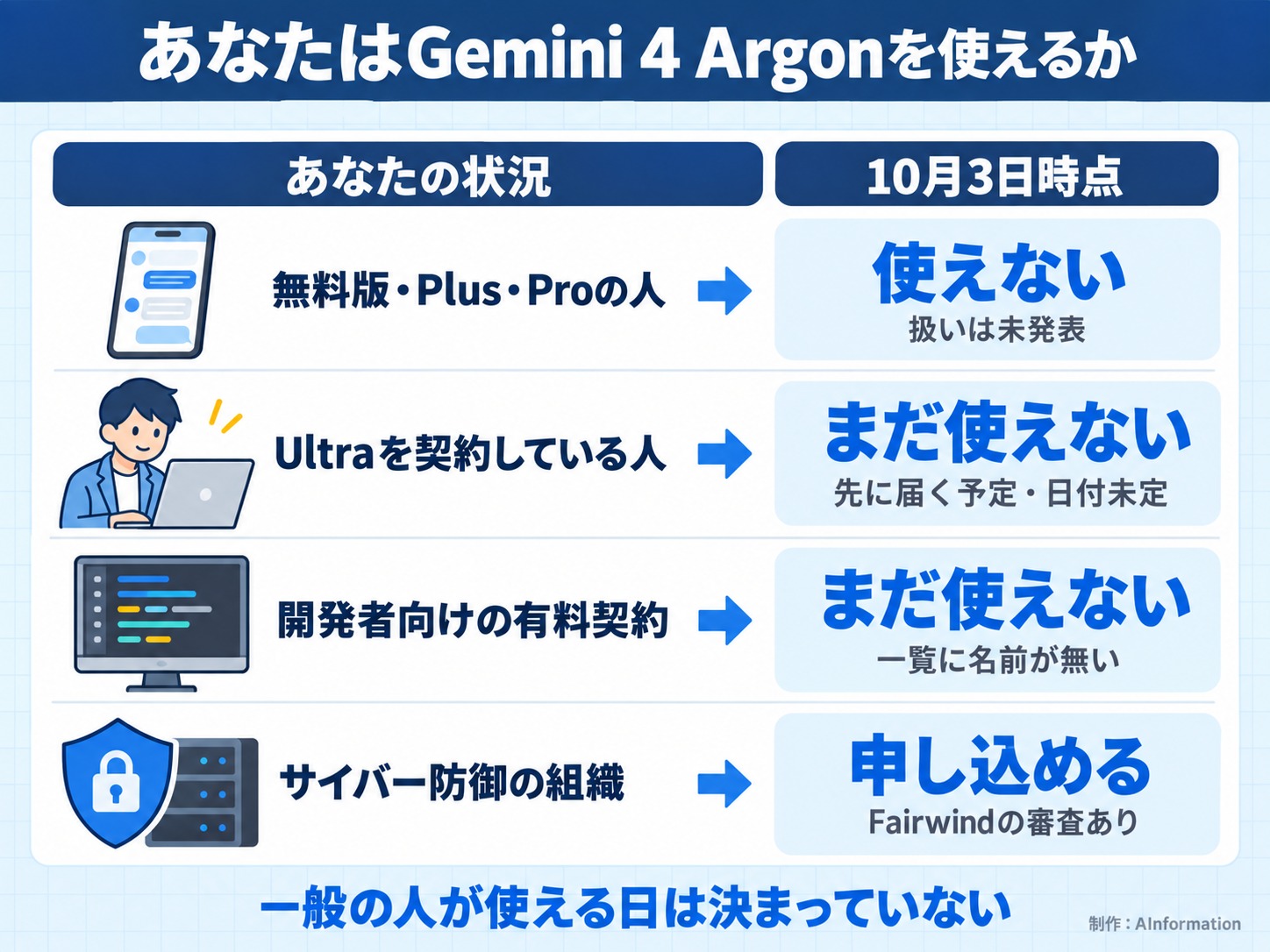
- Gemini 4 Argon is not available to the general public as of October 3. No release date has been set
- Next in line are paid developer accounts and Google AI Ultra subscribers (starting at ¥14,500 a month). Google has not said anything about Pro or the free tier
- AInformation checked three places — the Gemini app (Pro), AI Studio, and the developer model list — and found no sign of Argon in any of them
- The output limit rises from 64,000 to 1 million tokens. By AInformation’s count, that’s about 16.7 copies of the Japanese novel Botchan
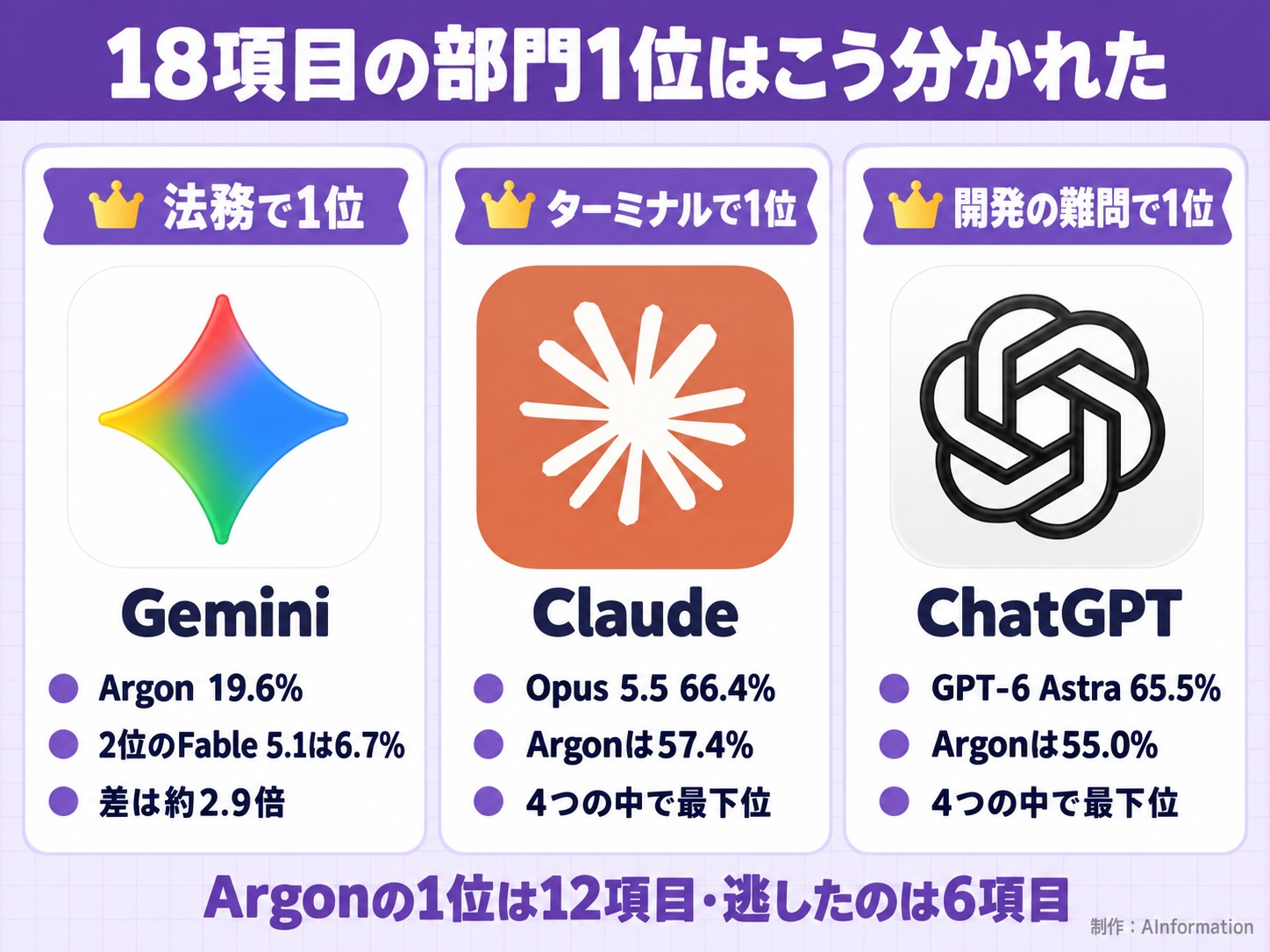
- Argon ranks first in 12 of the 18 categories in Google’s own benchmark table. It missed first place in 6 categories, including terminal-based coding
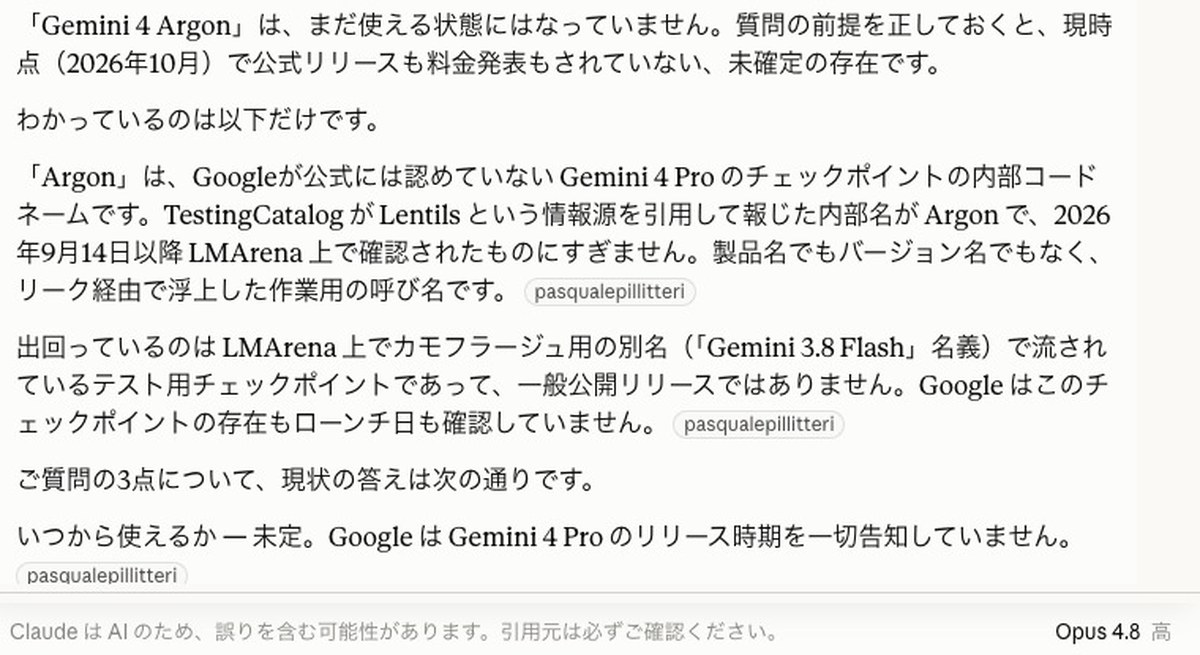
- Asking AIs produced different answers. Opus 4.8, the model selected in Claude’s interface, said it “has not been announced yet”
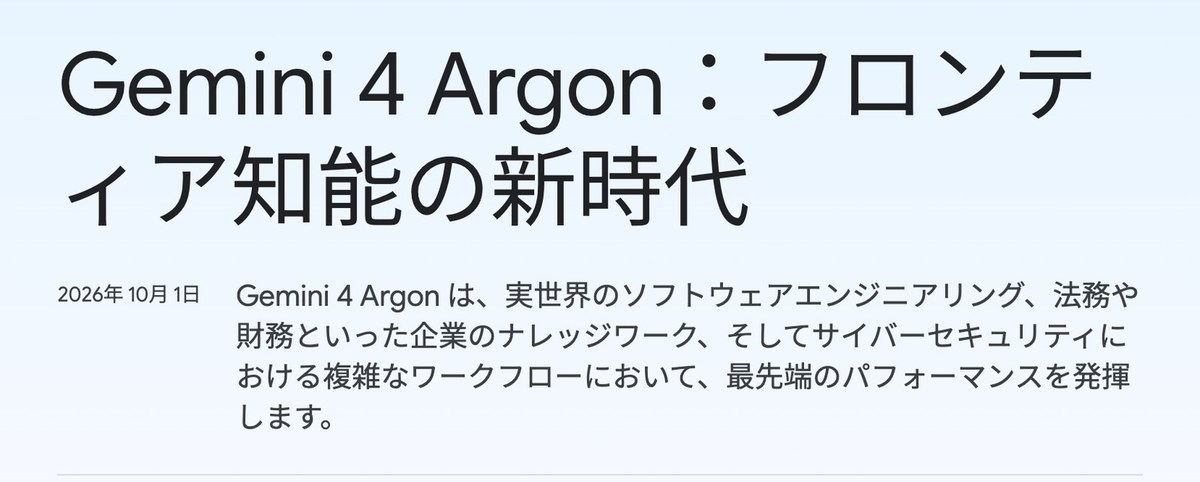
Google announced a new AI model on September 30, 2026. It’s called Gemini 4 Argon, and Google’s official Japanese blog post is dated October 1. It’s the first Gemini model to carry the number “4,” so many people who saw the announcement likely wondered: Can I use it already? How much does it cost?
Here’s the short answer. As of October 3, 2026, there is no way for the general public to use Gemini 4 Argon. No release date has been announced either. Right now it’s limited to vetted cyber-defense organizations and Google’s own internal teams.
AInformation looked for Argon in three places on the morning of October 3: the Google AI Pro app (¥2,900 a month), the developer-facing Google AI Studio, and the developer model list. We also asked four AIs, “When will Gemini 4 Argon be available?” and tallied the wins and losses across the 18 categories in Google’s official benchmark table. Below, we look at what the actual screens and numbers show — details the announcement text alone doesn’t make clear.
When will Gemini 4 Argon be available?
The official announcement doesn’t give a single release date. All it specifies is the order in which access will roll out.
The first to get access are organizations in the Fairwind Program, a track Google launched on September 2, 2026, for government agencies and critical-infrastructure operators handling cyber defense. More than 650 organizations worldwide take part. Some of them, along with Google’s internal teams, are already using Argon.
Next in line are paid API (developer access) users and subscribers to Google AI Ultra, the top-tier Gemini app plan. After that, Google says it will expand to developers, businesses, and general users. As for timing, Google says only that it will happen “as soon as possible.” Before a wider release, Argon is also going through the US government’s pre-release model review process.
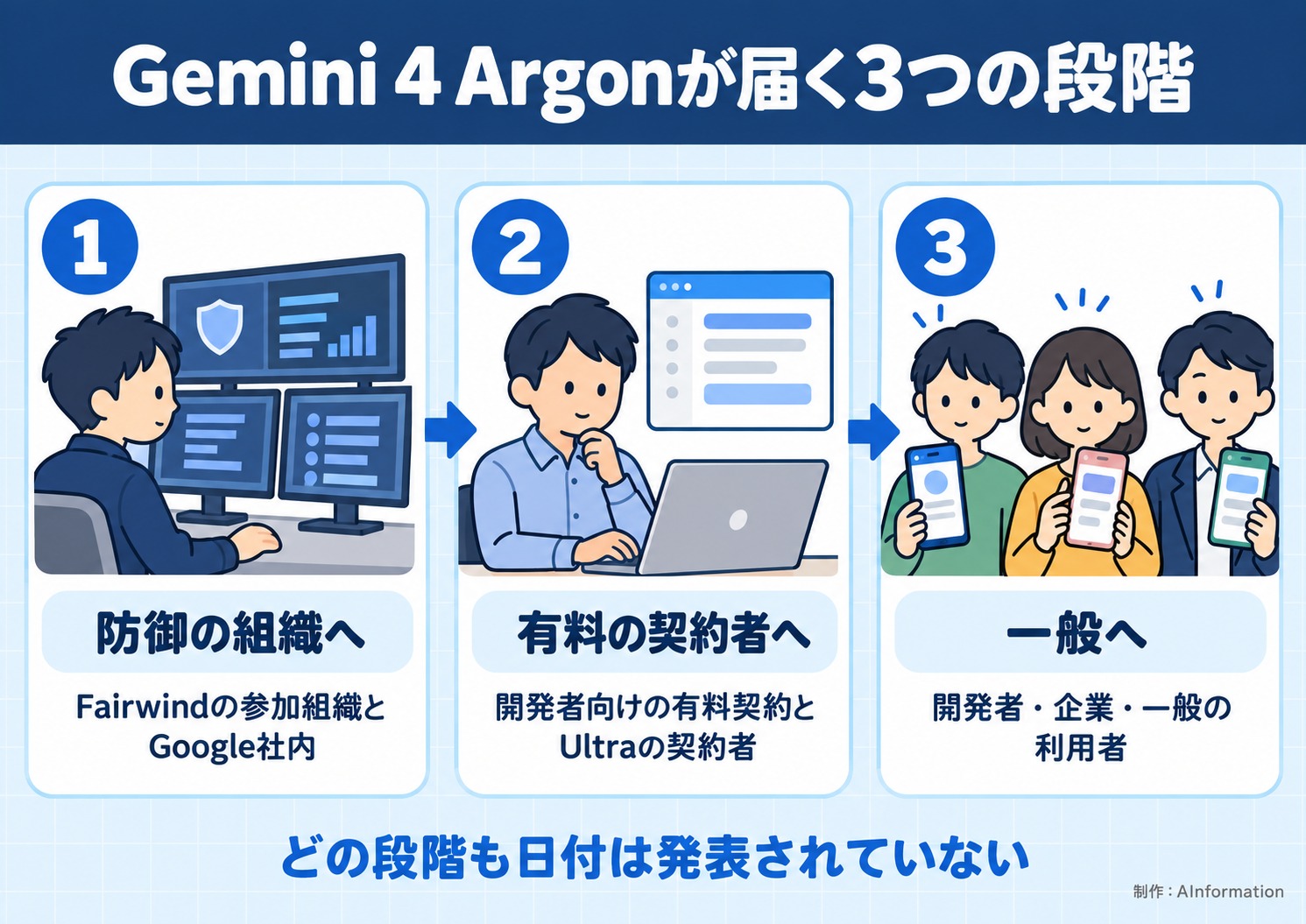
In short, there’s no visibility at all into when Google AI Pro or the free Gemini app will get access. The announcement names only the paid API and Ultra; it says nothing about Pro or the free tier.
Compared with past rollouts, this one is cautious. When AInformation tested GPT-6 Astra in September, it was callable through the developer API just two days after launch. Argon still doesn’t appear in the developer model list on October 3, three days after its announcement.
Can you select Argon in Gemini right now?
No. AInformation checked three places on October 3, three days after the September 30 announcement, and got the same result in all three. Here’s what we found on each screen where Argon could not be selected.
Model selection in the Gemini app (Google AI Pro)
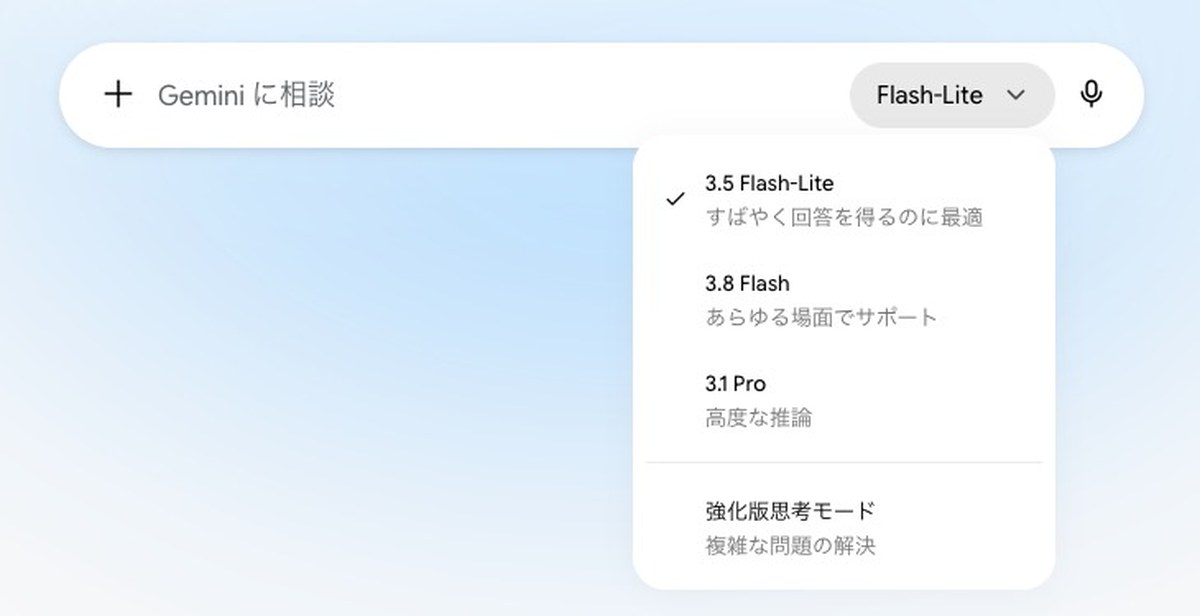
At 10:59 a.m. we opened the Gemini app and tapped the model switcher next to the input box. Four options appeared: “3.5 Flash-Lite,” “3.8 Flash,” “3.1 Pro,” and “Enhanced thinking mode.” Neither Argon nor any model named Gemini 4 appeared. We used a Google AI Pro account priced at ¥2,900 a month.
On the same screen, we asked Gemini, “Can I switch to Gemini 4 Argon from this screen?” It replied, “You cannot switch directly to Gemini 4 Argon from this current chat screen.”
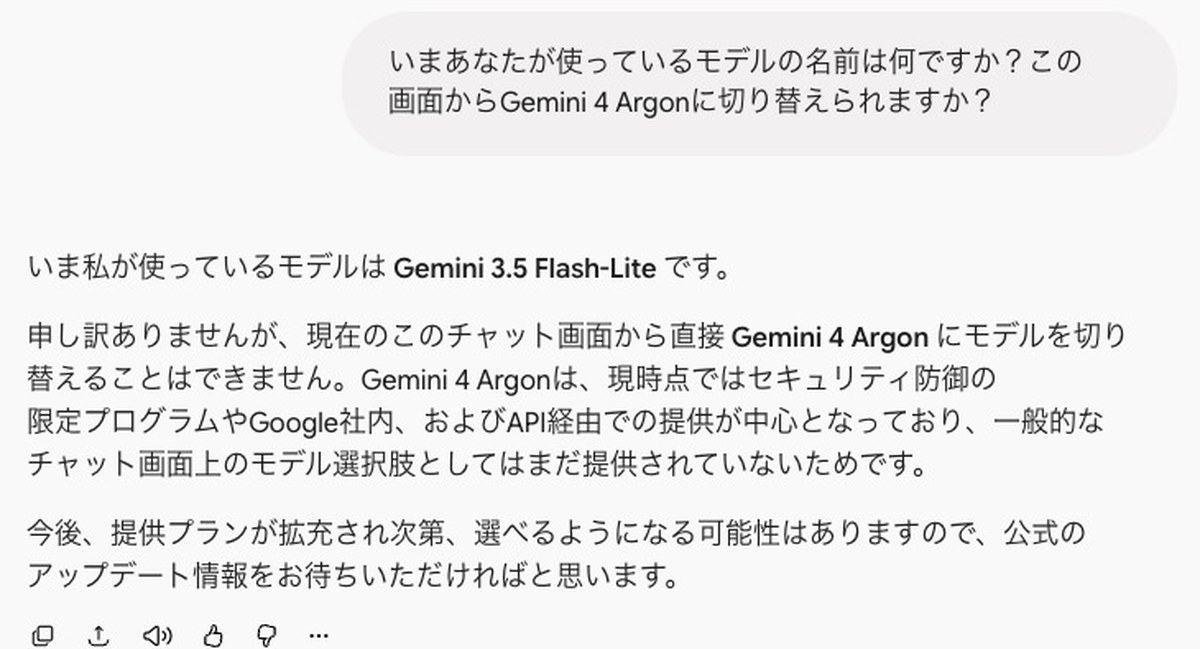
That answer contains one error, though. It said Argon is offered “mainly through the API.” But as we show below, Argon isn’t available through the developer API yet either.
Model list in Google AI Studio
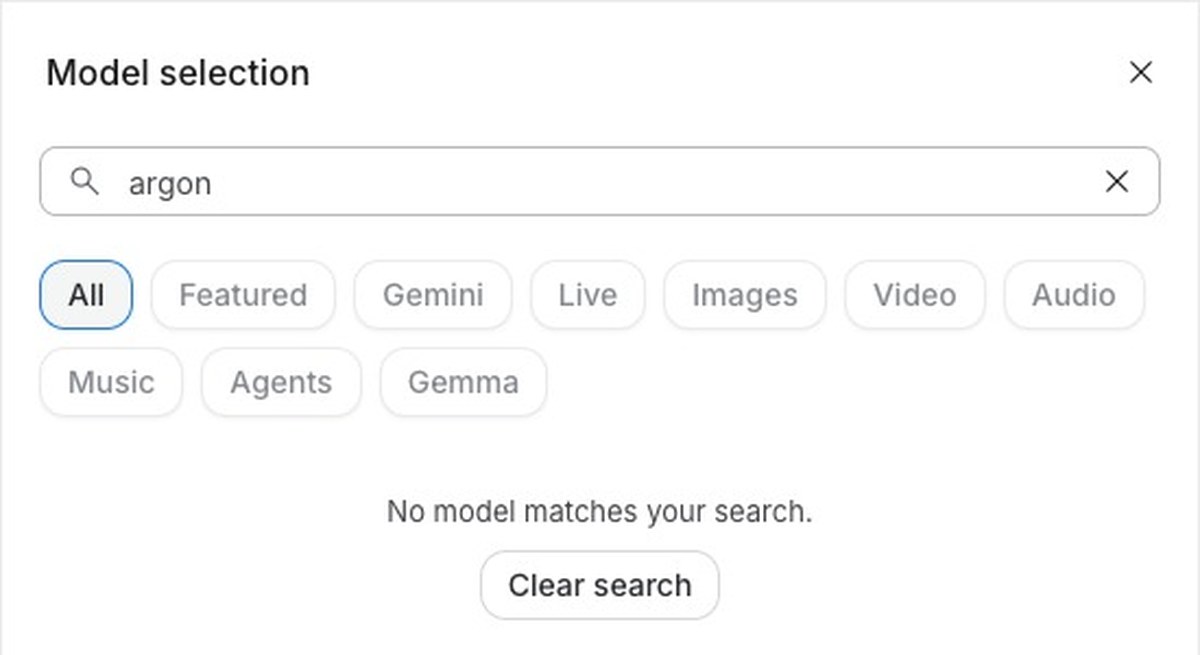
Google AI Studio is where developers typically try new models first. At 11:17 a.m. we switched the model-selection list to “All” and found 40 models listed. Searching “argon” or “gemini 4” both returned “No model matches your search.”
Developer model list
Finally, at 10:55 a.m. we queried the developer API for a list of currently available models. It returned 61 models, and Gemini 4 Argon was not among them. Querying by the specific name “gemini-4-argon” returned a “not found” error. For text models like 3.1 Pro and 3.8 Flash, the output limit was 65,536 tokens — matching the “previous 64,000 tokens” mentioned in the announcement.
Results of looking for Gemini 4 Argon in three places
| Where we looked | Time checked | Result |
|---|---|---|
| Model selector in the Gemini app (Google AI Pro) | 10:59 | Only 4 models: 3.5 Flash-Lite, 3.8 Flash, 3.1 Pro, and the enhanced thinking mode |
| Full model list (All) in Google AI Studio | 11:17 | 40 models. No match when searching for ‘argon’ or ‘gemini 4’ |
| Model list for developers | 10:55 | 61 models. Not found when specifying gemini-4-argon |
You can check for yourself whether Argon has reached your account. There are two places to look.
- Gemini app: Tap the model name to the right of the input box and check whether the list includes a name with “Argon” or “4”
- Google AI Studio: Tap the model name in the top right, select “All,” then type “argon” in the search box. If it’s still set to “Featured,” the list is filtered
Watch out for models with similar names too. Google AI Studio’s list also includes a model called “Gemma 4.” This is a separate model line that Google publishes, and it’s not the same as Gemini 4 Argon.
How much does Gemini 4 Argon cost?
Pricing for use through the Gemini app’s monthly plans has not been announced. Two things are known: Google AI Ultra will get access first, and the developer pricing has been published.
In the Gemini app, Ultra gets access first
Google AI Ultra in Japan starts at ¥14,500 a month. Checking Google’s official pricing page on October 3 showed four plans: Free, Plus, Pro, and Ultra. Ultra is split into two tiers based on usage limits. The differences between Plus and Pro, and the gap with the free version, are covered in our article on Gemini’s paid plans, along with results from the same 20 questions.
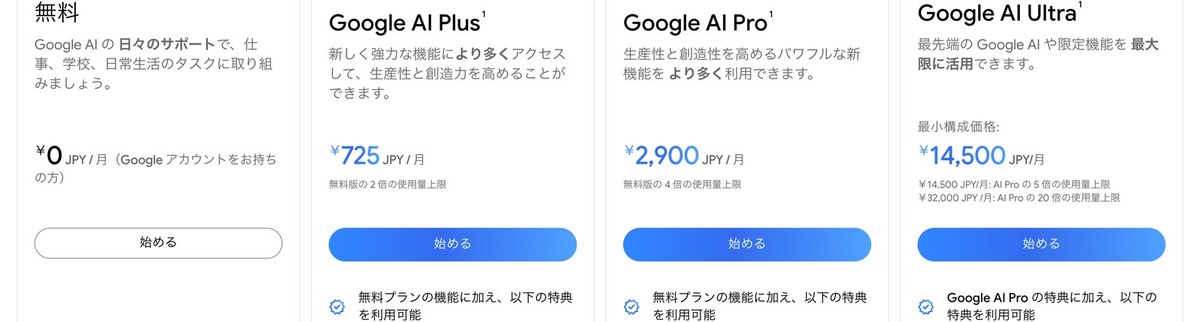
Gemini’s Japan pricing plans and the status of Gemini 4 Argon
| Plan | Monthly price | Gemini 4 Argon |
|---|---|---|
| Free | ¥0 | Not yet announced |
| Google AI Plus | ¥725 | Not yet announced |
| Google AI Pro | ¥2,900 | Not yet announced |
| Google AI Ultra (5x Pro’s limit) | ¥14,500 | Scheduled to arrive first, date not set |
| Google AI Ultra (20x Pro’s limit) | ¥32,000 | Scheduled to arrive first, date not set |
Going from Pro’s ¥2,900 to Ultra’s ¥14,500 adds ¥11,600 a month. However, signing up for Ultra now won’t get you Argon. Ultra’s description says you get early access to advanced features like Deep Think and Gemini Spark, but it does not mention Argon by name. It’s fine to wait for the official launch announcement before switching to Ultra.
Developer pricing doubles after the introductory period
Developer pricing has been published. The price is based on the volume of input and output tokens, and the current price is a limited-time introductory rate. A note in the announcement says that once the introductory period ends, both input and output prices double. The announcement does not say when the introductory period ends.
To make comparisons with other models easier, we set Argon’s introductory price as 1 and expressed the rest as multiples of it. All figures were checked against each company’s official pricing page on October 3.
Developer unit prices compared, with Argon’s introductory price set as 1
| Model | Input price | Output price |
|---|---|---|
| Gemini 4 Argon (introductory price) | 1 | 1 |
| Gemini 4 Argon (after introductory period) | 2x | 2x |
| Gemini 3.1 Pro | 1 | 1.2x |
| Claude Sonnet 5.5 | 1 | 1 |
| GPT-6.1 Sol | 1 | 1 |
| Claude Opus 5.5 | 2x | 2x |
| GPT-6 Astra | 5x | 5x |
| Claude Fable 5.1 | 5x | 5x |
During the introductory period, Argon’s price is half of Claude Opus 5.5’s. Compared with GPT-6 Astra and Claude Fable 5.1, it’s a fifth of the price. Once the introductory period ends, it matches Opus 5.5’s price. Compared with the previous Gemini 3.1 Pro, the input price is the same during the introductory period. Output is priced 1.2 times higher for 3.1 Pro.
What changed with Gemini 4 Argon
The biggest change is the limit on how much output you can get in one response. According to the announcement, the output limit grew from the previous 64,000 tokens to 1 million tokens, about 15.6 times larger.
Tokens are the unit AI models use to count text. How many Japanese characters a token equals varies by sentence, so our editorial team measured it directly using Google’s own counting method, with the token-counting tool published for developers. Gemini 3.1 Pro and 3.8 Flash both returned the same value.
How many characters is one token in Japanese?
| What was measured | Botchan (Natsume Soseki) | AInformation article (pricing explainer) | Google’s official blog (English) |
|---|---|---|---|
| Character count | 88,272 characters | 11,149 characters | 9,177 characters |
| Tokens | 60,002 | 6,405 | 2,112 |
| Characters that fit in 65,536 tokens | about 96,000 characters | about 114,000 characters | about 285,000 characters |
| Characters that fit in 1 million tokens | about 1.47 million characters | about 1.74 million characters | about 4.35 million characters |
Natsume Soseki’s novel Botchan runs 88,272 characters in the main text, which comes to 60,002 tokens when counted. Gemini’s current limit is almost exactly the length of one copy of Botchan, and Argon’s 1 million tokens is about 16.7 copies of it. For business writing like an AInformation article, one token works out to about 1.74 characters, so 1 million tokens comes to about 1.74 million characters.
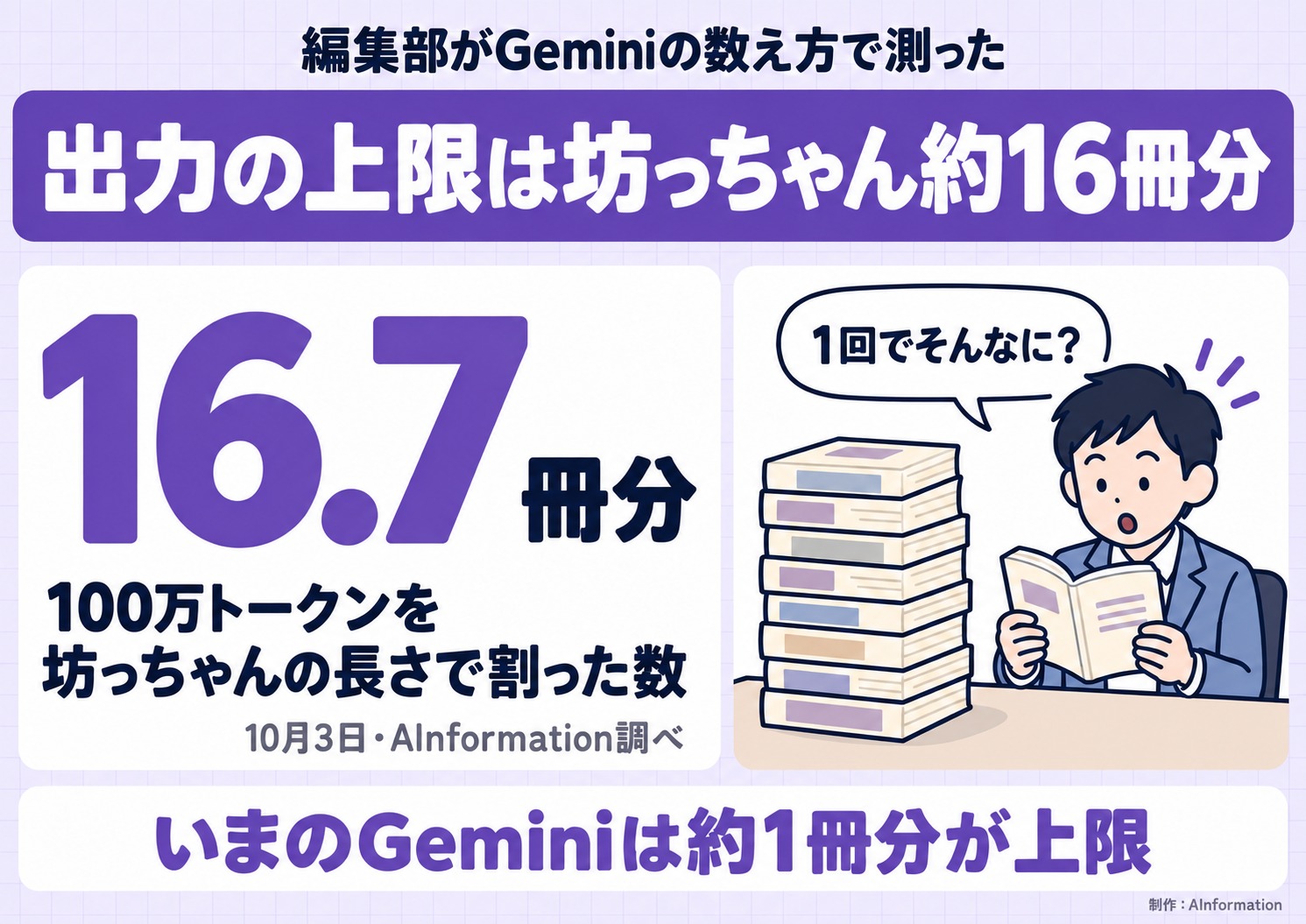
There are two things to keep in mind, though. First, most of that limit gets used for “thinking.” Google explains that having room to generate hundreds of thousands of tokens within a single flow is what allows for deeper reasoning. You won’t actually get back a full 1 million tokens of text in one response.
Second, Argon’s own tokenization method hasn’t been made public. The figures above were measured using the current Gemini counting method, and there’s no guarantee the numbers would be the same for Argon. For reference, counting Google’s official English-language blog post the same way came out to 4.345 characters per token. Compared with 1.471 characters per token in Japanese, that means the same number of characters uses about 2.95 times as many tokens in Japanese as in English.
Results from inside Google
Google has also shared results from using Argon internally. The company says thousands of employees are already using it for their work.
- In quantum computing research, it beat a published benchmark score by 40% in just a few minutes
- It reviewed memory usage across an entire data center and freed up 300 TiB or more (with an estimated total of 500 TiB to 1 PiB)
- It’s being used to port programs written in C/C++ to Rust, on a project spanning more than 800,000 lines of code
- For the video-decoding software libgav1, it rewrote 32,000 lines of processing code and made it 2.7 times faster
All of these are results Google produced in its own environment. They don’t show that other companies would get the same results on their own work.
Does Gemini 4 Argon outperform GPT-6 Astra?
In the performance table Google released, Argon is compared against three other models across 18 categories. The rivals are GPT-6 Astra, Claude Fable 5.1, and Claude Opus 5.5. Argon took sole first place in 12 categories and missed first place in 6. One of those six was a tie.
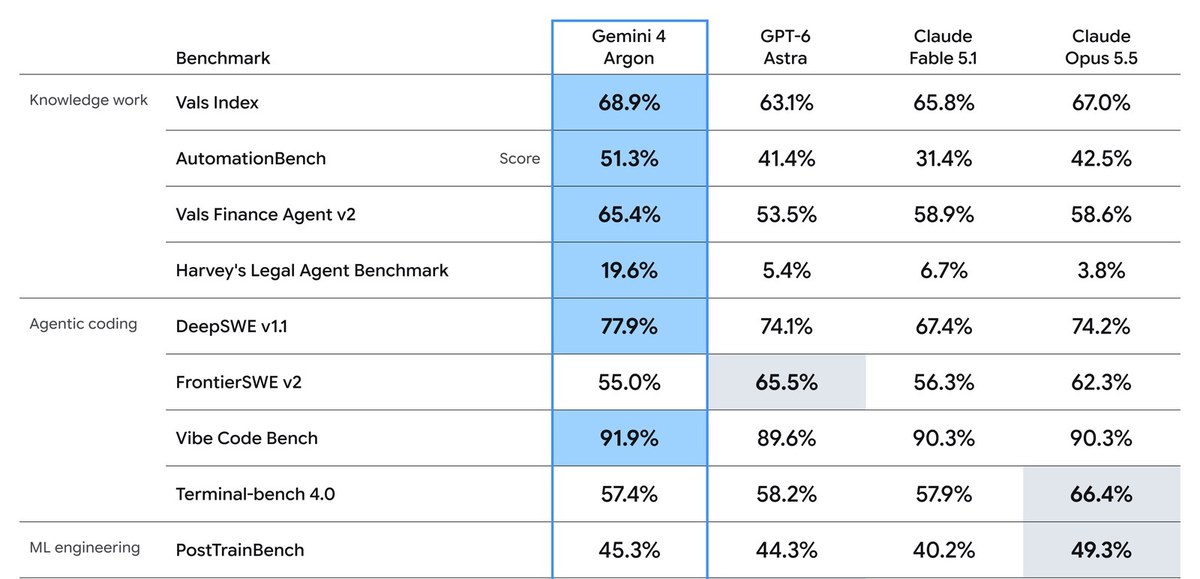
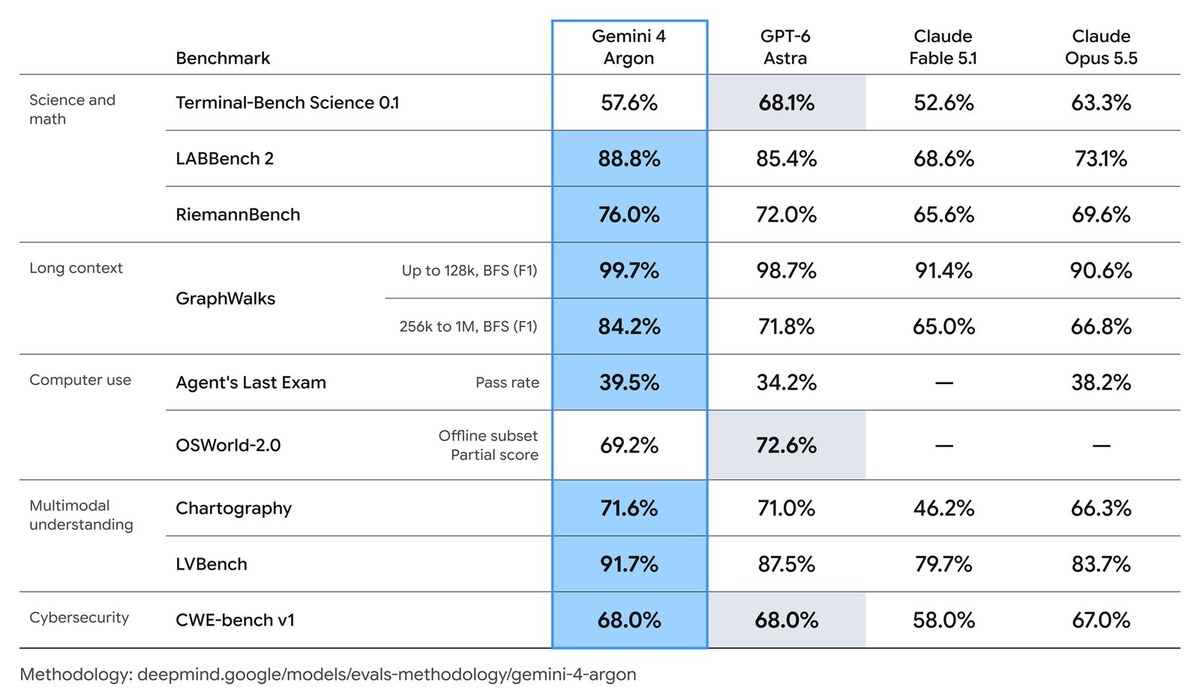
Most news coverage reports that Argon “led in 12 categories.” Here, let’s look at the other 6 categories.
The 6 categories where Gemini 4 Argon missed first place
| Category (what it measures) | Argon | Top-scoring model | Argon’s rank |
|---|---|---|---|
| FrontierSWE v2 (difficult coding tasks) | 55.0% | GPT-6 Astra 65.5% | 4th out of 4 |
| Terminal-bench 4.0 (working in a terminal) | 57.4% | Claude Opus 5.5 66.4% | 4th out of 4 |
| Terminal-Bench Science 0.1 (scientific tasks) | 57.6% | GPT-6 Astra 68.1% | 3rd out of 4 |
| PostTrainBench (additional AI training) | 45.3% | Claude Opus 5.5 49.3% | 2nd out of 4 |
| OSWorld-2.0 (operating a computer) | 69.2% | GPT-6 Astra 72.6% | 2nd out of 2 |
| CWE-bench v1 (fixing vulnerabilities) | 68.0% | Tied with GPT-6 Astra | Tied for 1st |
The coding categories stand out. In two of them, Argon ranked last among the four models: FrontierSWE v2, which tests solving difficult coding challenges, and Terminal-bench 4.0, which tests working in a terminal (a command-line screen). Argon trailed GPT-6 Astra by 10.5 points on FrontierSWE v2 and trailed Claude Opus 5.5 by 9.0 points on Terminal-bench 4.0. Anyone planning to hand coding work over to AI should note that the top spot shifts even among coding benchmarks, so they don’t pick the wrong model.
On the other hand, some of the 12 categories where Argon came in first show a wide lead over the competition. On Harvey’s Legal Agent Benchmark, which measures legal research and document drafting, Argon scored 19.6%, about 2.9 times the second-place Claude Fable 5.1’s 6.7%. On GraphWalks, which tests tracing through long documents of 256,000 to 1 million tokens, Argon beat the second-place GPT-6 Astra by 12.4 points.
The 12 benchmarks where Gemini 4 Argon ranked first (GraphWalks counted as two rows by length)
| Benchmark | Category | Argon | Gap over 2nd place (model) |
|---|---|---|---|
| Vals Index | Knowledge work | 68.9% | 1.9 (Opus 5.5) |
| AutomationBench | Knowledge work | 51.3% | 8.8 (Opus 5.5) |
| Vals Finance Agent v2 | Knowledge work | 65.4% | 6.5 (Fable 5.1) |
| Harvey’s Legal Agent Benchmark | Knowledge work | 19.6% | about 2.9x (Fable 5.1) |
| DeepSWE v1.1 | Development | 77.9% | 3.7 (Opus 5.5) |
| Vibe Code Bench | Development | 91.9% | 1.6 (Fable 5.1 and Opus 5.5) |
| LABBench 2 | Science | 88.8% | 3.4 (Astra) |
| RiemannBench | Math | 76.0% | 4.0 (Astra) |
| GraphWalks (up to 128,000 tokens) | Long documents | 99.7% | 1.0 (Astra) |
| GraphWalks (256,000–1,000,000 tokens) | Long documents | 84.2% | 12.4 (Astra) |
| Agent’s Last Exam | Computer use | 39.5% | 1.3 (Opus 5.5) |
| Chartography | Images and video | 71.6% | 0.6 (Astra) |
| LVBench | Images and video | 91.7% | 4.2 (Astra) |
Where the numbers come from also matters. According to Google’s evaluation methodology document, most of the scores for other companies’ models were taken from each company’s own published figures or public leaderboards. For 4 benchmarks, including GraphWalks and LVBench, Google measured all 4 models itself. There are also 5 benchmarks, including DeepSWE and Terminal-bench 4.0, where Google measured only Argon itself. For Terminal-Bench Science, the document notes that the grading wait time was extended to 6 times the normal length. Keep in mind that not every benchmark was measured under the same conditions.
What four AI chatbots said when asked, “When can I use Gemini 4 Argon?”
Many people probably just ask an AI chatbot about a new model. So between 10:59 a.m. and 11:06 a.m. on October 3, we sent the same question to Gemini, Claude, and Microsoft Copilot. The question was: “When can I use Gemini 4 Argon? Please also tell me the pricing and what has changed from the previous model.” We left each app’s settings at their defaults, and for both Gemini and Claude we asked a second time after switching models. We sent the same question to ChatGPT at 11:44 a.m.
We checked the answers on three points. For the “when,” an answer was marked correct if it said the model isn’t available to the general public yet and that no date has been announced. For pricing, an answer was marked correct if it correctly stated the introductory price and the price after the introductory period. For “what changed,” an answer was marked correct if it mentioned that the output limit increased to 1 million tokens.
Answers to “When can I use Gemini 4 Argon?”
| AI (model shown on screen) | When | Pricing | What changed | Time to answer |
|---|---|---|---|---|
| Gemini (3.5 Flash-Lite) | Correct | Correct | Correct | 19.0 seconds |
| Gemini (3.1 Pro) | Correct | Correct | Correct | 47.9 seconds |
| Claude (Opus 4.8) | Incorrect — said it hadn’t been announced yet | Incorrect — said pricing was unannounced | Incorrect — said 4x | 30.6 seconds |
| Claude (Fable 5.1) | Correct | Correct | Correct | 26.6 seconds |
| Microsoft Copilot (Auto) | Correct | Correct | Correct | 22.2 seconds |
| ChatGPT (set to Medium on screen) | Correct | Correct | Correct | 41.5 seconds |
Claude got it wrong. The Opus 4.8 model selected on screen opened with: “Gemini 4 Argon isn’t available for use yet.” It went on to say, “It’s an unconfirmed entity, with no official release or pricing announcement.” This answer came after a web search. However, the sources it pulled from were pre-announcement leaks, and it got the September 30 announcement itself wrong. It also described the output limit increase as “reportedly 4x,” which doesn’t match the official figure of about 15.6x.
When we switched the same Claude app to the top-listed Fable 5.1 and asked again, it answered all three points correctly. For Gemini, both the on-screen default 3.5 Flash-Lite and 3.1 Pro answered correctly, and Copilot also answered correctly. ChatGPT got all three points right as well, citing Google’s official blog as its source. For a model announced just days earlier, the answers varied less by which AI chatbot was asked than by which underlying model handled the question.
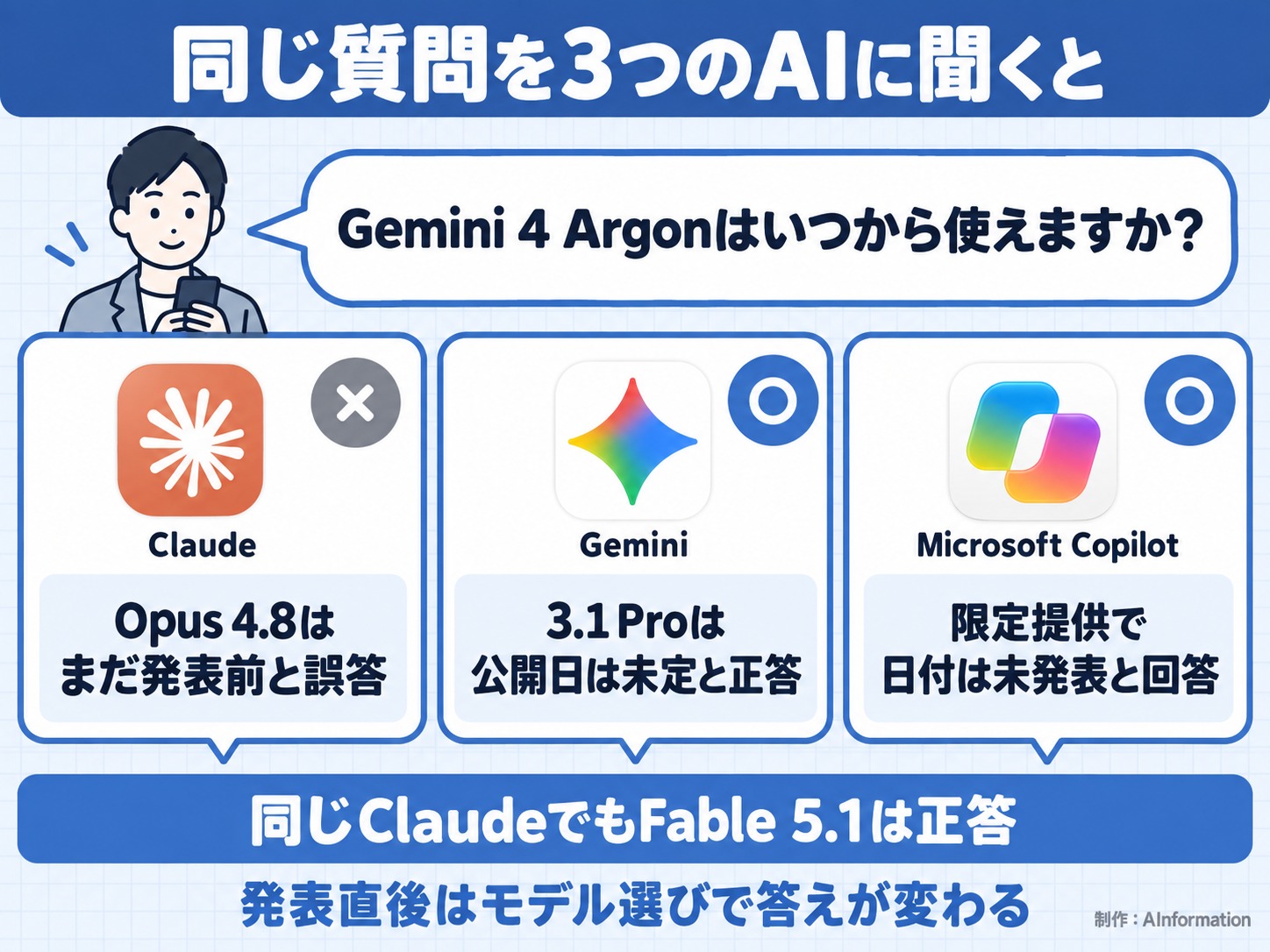
Before you use an AI’s answer, the safest step is to open the source link it cites and compare it with the official announcement. The sources Gemini’s answer cited were explainer articles from other companies, such as LEAPH and Money Forward Admina, not Google’s own announcement.
Why give it to cyber defense organizations first?
The reason it goes to cyber defense organizations before the general public comes down to Argon’s defensive power. According to the announcement, Argon can find serious software vulnerabilities on its own, verify them, and even fix them. Google says it is releasing a version of Argon without the guardrails that refuse cyberattack requests to trusted defenders and its own teams.
The idea is that a powerful tool can also be used for attacks, so Google hands it to defenders first to give them time to prepare. The official Fairwind Program page lists the conditions for taking part.
- There are three eligible categories: governments and national cyber defense agencies, critical infrastructure operators, and companies with a technology base
- Critical infrastructure covers areas such as health care, telecommunications, energy and finance
- Only an organization’s security, incident response, and penetration testing teams can use it
- Participants must set up phishing-resistant multi-factor authentication and log employee usage
- Usage rights cannot be transferred or sold to another company. Applicant organizations are screened on their security track record and ethics
University research labs that study defensive evaluation can also apply. The official page, as of October 3, does not say whether organizations in Japan can take part.
Google says it will strengthen safeguards in four areas before releasing the model more widely.
- Prevent use in cyberattacks or chemical, biological, radiological and nuclear weapons
- Prevent it from being hijacked by instructions injected from outside (prompt injection)
- Monitor the AI’s reasoning process so it does not act beyond the user’s intent
- Close off and harden the testing environment from outside access
Why the name Argon instead of Pro, and the 229-day gap
This model was released under the name “Gemini 4 Argon,” not “Gemini 4 Pro.” The official announcement does not explain the reason for the name.
The previous Pro model, listed in the AI Studio catalog, is Gemini 3.1 Pro Preview, dated February 13, 2026. That leaves a gap of 229 days before the Argon announcement. During that period, only models in the Flash line were released. Counting by the dates in the AI Studio catalog, four Flash models came out, from 3.5 Flash on May 20 to 3.8 Flash on September 3. According to ITmedia NEWS, Google said when it announced 3.5 Flash that it would release the higher-tier Pro model in June. That did not happen.
It seems many people were waiting. According to Google’s Keyword Planner, “gemini 4” was searched 3,600 times in August alone, before the announcement. “gemini 4 pro” was searched 320 times in August as well, which shows that quite a few people expected it to be released under the name Pro.
What to use until Gemini 4 Argon arrives
The top model currently available to choose in the Gemini app is 3.1 Pro. There is also an “enhanced thinking mode” for complex problems. According to the official pricing page, even the free plan lets you use 3.1 Pro, with a usage limit. Until Argon becomes available, you will need to choose from these options.
If you already use Gemini for work, it is faster to build your workflow around today’s 3.1 Pro rather than wait for Argon. Even when the model changes, the way you prompt it and check its output will still apply. We also cover how to use Gemini in how to use Gemini’s skills and how to create meeting minutes with Gemini.
Summary
Here is a summary of what is known about Gemini 4 Argon as of October 3, 2026.
- The general public still cannot use it. No release date has been set, and Google has not announced how it will be handled for Google AI Pro or the free plan
- Fairwind participant organizations and Google’s internal teams get access first. Next come paid developer contracts and Google AI Ultra (from ¥14,500 a month)
- Argon was not available anywhere we checked: the Gemini app, AI Studio, or the developer catalog
- The output limit is 1 million tokens, equivalent to about 16.7 copies of the Japanese novel Botchan
- It ranked first in 12 of the 18 official benchmarks. It did not rank first in six, including terminal-based development
- When asked, Claude Opus 4.8 answered that it “has not been announced yet”
Once it becomes available, Argon should appear as a name in the Gemini app’s model selector. If you are curious, check back from time to time. We also cover what was announced on launch day in news coverage of the Gemini 4 Argon announcement.
- What is Gemini 4 Argon?
- It’s the latest AI model, announced by Google on September 30, 2026. It’s the first model released in the “4” generation of Gemini. It’s said to be strong at tasks that take a long time to complete, legal and financial work, and cyber defense. Its maximum output per request is 1 million tokens.
- When can I start using Gemini 4 Argon?
- As of October 3, 2026, no release date for general users has been announced. It will first go to organizations in the Fairwind Program and Google’s internal teams, then expand to paid developer contracts and Google AI Ultra subscribers.
- Can I use it with the free plan or Google AI Pro’s Gemini?
- This hasn’t been announced. The announcement only names the paid API and Ultra. When AInformation’s editors checked the Google AI Pro app on October 3, Argon didn’t appear among the model options.
- How much does Gemini 4 Argon cost?
- Pricing for use in the Gemini app hasn’t been announced. Google AI Ultra, which is expected to get access first, starts at ¥14,500 per month. Developer pricing has been published, and it doubles once the rollout period ends.